Why your Vedic sign differs from your Western sign: ayanamsa
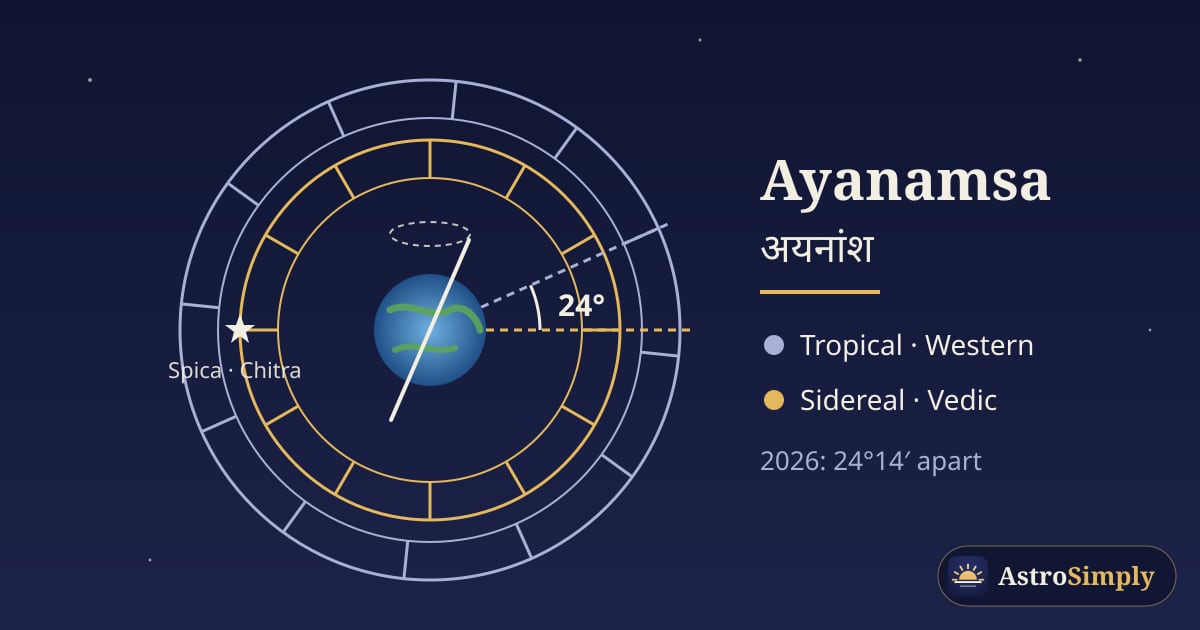
Your Vedic sign is usually one sign earlier than your Western one. The reason is the ayanamsa, a shift of about 24 degrees. How it's measured, with 2026 dates.
Share these images
Send them to family and friends on WhatsApp, or save them to your phone.
If a Western horoscope calls you a Leo and your kundali says Karka (Cancer), neither one is a typo. Western astrology and Indian (Vedic) astrology measure the zodiac from two different starting points, and right now those starting points are about 24 degrees apart. That gap is called the ayanamsa, and it moves most people back one sign. This post explains where the gap comes from, how it’s measured, and how we compute it in the AstroSimply engine. I build the tools, so I’ll show you the numbers.
One sky, two rulers
Both systems divide the Sun’s yearly path, the ecliptic, into twelve equal slices of 30 degrees. They disagree only about where the first slice, Aries (Mesha), begins.
Western astrology uses the tropical zodiac: Aries starts at the exact spot where the Sun stands on the March equinox, the day when day and night are equal. That spot is tied to the seasons. Vedic astrology uses the sidereal zodiac, called nirayana in Sanskrit, “without the ayana shift”: Aries starts at a fixed point among the stars, so the signs stay with the constellations they’re named after.
Around 1,700 years ago both starting points were in the same place, and the two zodiacs agreed. They haven’t agreed since, because the equinox point doesn’t stay still.
Why the equinox drifts: the wobble Hipparchus noticed
The Earth spins on a tilted axis, and the pull of the Sun and the Moon on its equatorial bulge makes that axis trace a slow circle, the way a spinning top wobbles. One full circle takes about 25,800 years. As the axis turns, the equinox point slides backwards along the ecliptic by about 50.3 arcseconds a year, which is one degree every 72 years or so. The Greek astronomer Hipparchus spotted this in the second century BCE by comparing his star positions with older records. Indian astronomers knew it too, and the word itself says what it measures: ayana is the course or movement, amsha the portion, so ayanamsa is the portion by which the course has moved.
So the tropical zero point creeps westward against the stars, and the sidereal zero point stays put. The distance between them today is the ayanamsa.
Which fixed star? The Lahiri answer
Here’s the subtle part. “A fixed point among the stars” still has to be chosen, and different astrologers chose slightly differently. India settled the question officially in the 1950s. The Calendar Reform Committee, set up by the Government of India in 1952 under the physicist Meghnad Saha, with the astronomer N. C. Lahiri as its secretary, reported in 1955 and fixed the ayanamsa at 23°15’00” as on 21 March 1956. The value was chosen so that the bright star Spica, Chitra in the nakshatra system, sits within a few arcminutes of 180 degrees, the start of sidereal Libra. The scheme is called the Lahiri or Chitrapaksha ayanamsa, and it’s what most Indian panchangs, software and astrologers use. AstroSimply uses it too.
Other choices exist. B. V. Raman’s ayanamsa runs roughly a degree and a half smaller than Lahiri; the Krishnamurti (KP) value is a few arcminutes smaller; Western sidereal astrologers often use Fagan-Bradley, which is a little larger. For most people these differences don’t change a sign, but if a planet in your chart sits within a degree of a sign boundary, the choice of ayanamsa can move it. That’s one reason two Vedic apps occasionally disagree.
What the number is right now
The ayanamsa isn’t a constant. Our engine computes it fresh for every date, because it grows a little every day. Here’s what it returns for a few moments in time:
| Date | Lahiri ayanamsa (AstroSimply engine) |
|---|---|
| 21 March 285 CE | about 0°: the two zodiacs agree |
| 1 January 1900 | 22°28’ |
| 21 March 1956 | 23°15’ (the committee’s reference value) |
| 1 January 2000 | 23°51’ |
| 13 November 2026 | 24°14’ |
| 1 January 2100 | 25°15’ |
| 1 January 2440 | 30°00’: one whole sign |
So today the shift is 24°14’. In about four hundred years the two zodiacs will be a full sign apart, and a tropical Leo Sun will be a sidereal Cancer Sun for everyone, not just for those born in the first three weeks of the sign.
From your birth time to your sign: how we compute it
Here’s what happens when you enter a birth in the app.
- We convert your local birth time and place to universal time and compute, from an astronomical ephemeris, the tropical longitude of each planet: its position along the ecliptic measured from the equinox, which is the frame astronomers use.
- We compute the Lahiri ayanamsa for that exact moment.
- We subtract it. Tropical longitude minus ayanamsa gives sidereal longitude; if the result dips below zero, we add 360.
- We divide by 30 for the sign, by 13°20’ for the nakshatra, and by 3°20’ for the pada.
A worked example with the Sun, because it’s the easiest planet to follow. In 2026 the Sun enters tropical Scorpio on 23 October. Subtract 24 degrees and the Sun is still in sidereal Libra (Tula) that day; it doesn’t reach sidereal Scorpio (Vrishchika) until 16 November, the Vrishchika Sankranti our engine computes for this year. The Sun moves about a degree a day, so a 24-degree ayanamsa shows up as a 24-day delay. Anyone born between 23 October and 15 November is a Western Scorpio and a Vedic Libra. Anyone born from 16 to 21 November is Scorpio in both.
Your Sun sign in both zodiacs: the 2026 dates
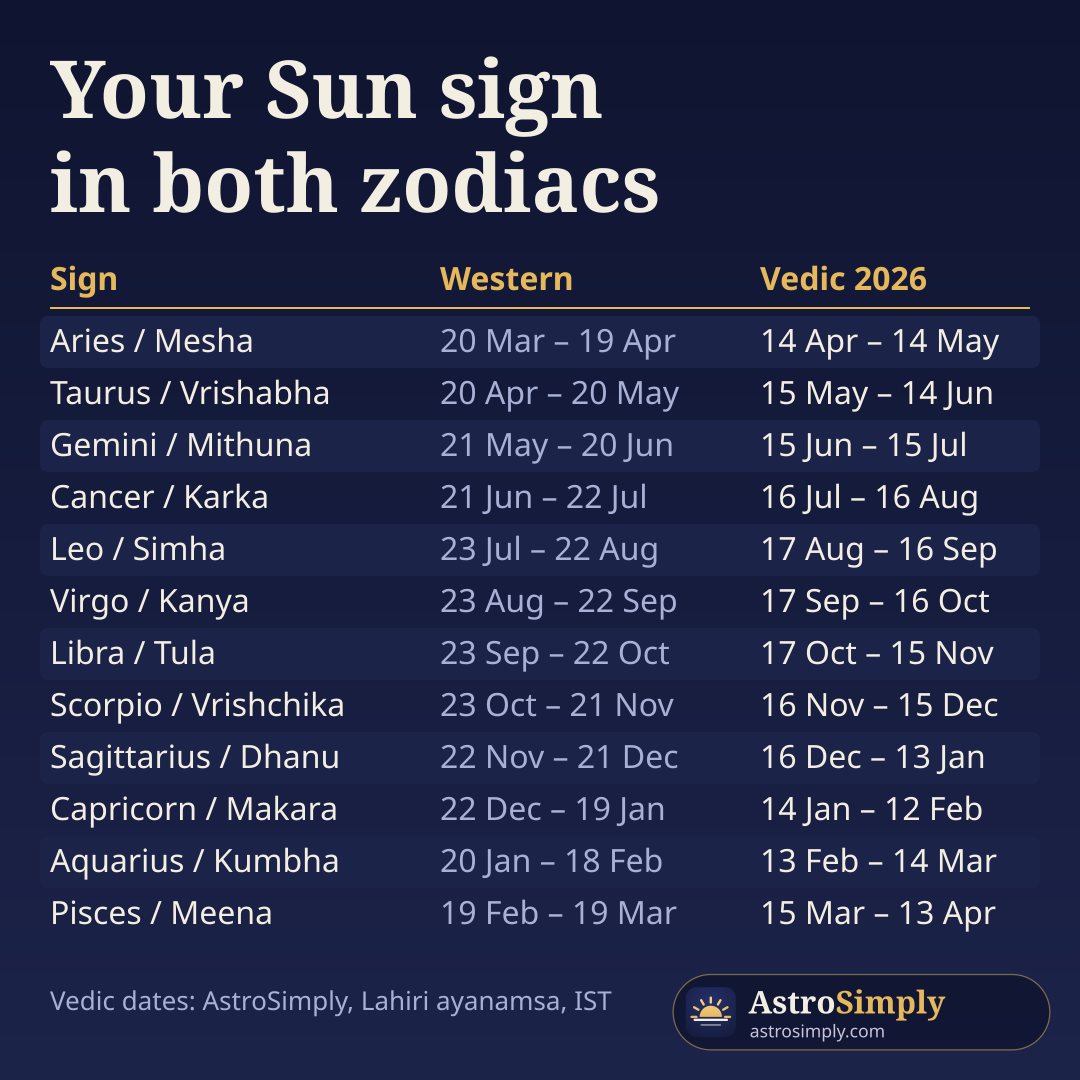
| Sign | Western (tropical) | Vedic (sidereal), 2026 |
|---|---|---|
| Aries / Mesha | 20 Mar – 19 Apr | 14 Apr – 14 May |
| Taurus / Vrishabha | 20 Apr – 20 May | 15 May – 14 Jun |
| Gemini / Mithuna | 21 May – 20 Jun | 15 Jun – 15 Jul |
| Cancer / Karka | 21 Jun – 22 Jul | 16 Jul – 16 Aug |
| Leo / Simha | 23 Jul – 22 Aug | 17 Aug – 16 Sep |
| Virgo / Kanya | 23 Aug – 22 Sep | 17 Sep – 16 Oct |
| Libra / Tula | 23 Sep – 22 Oct | 17 Oct – 15 Nov |
| Scorpio / Vrishchika | 23 Oct – 21 Nov | 16 Nov – 15 Dec |
| Sagittarius / Dhanu | 22 Nov – 21 Dec | 16 Dec – 13 Jan |
| Capricorn / Makara | 22 Dec – 19 Jan | 14 Jan – 12 Feb |
| Aquarius / Kumbha | 20 Jan – 18 Feb | 13 Feb – 14 Mar |
| Pisces / Meena | 19 Feb – 19 Mar | 15 Mar – 13 Apr |
The Western dates are the usual published ranges and shift by a day in some years. The Vedic dates are the sankranti dates our engine computes for 2026 in India (IST). A sankranti can fall at any hour, so if you were born on one of those boundary days, the exact time decides.
The same shift applies to the Moon, the rising sign (lagna) and every planet. The Moon changes sign every two to three days, so your Vedic Moon sign, the rashi, is a separate calculation. Our post on Sun, Moon and rising sign explains why Indian astrology leads with the Moon, and understanding your Moon sign goes into what the rashi is used for.
So which one is right?
Both, for what they measure. The tropical zodiac is a calendar of the seasons: tropical Aries always begins at the March equinox, and tropical Capricorn always begins at the December solstice, whatever the stars do. The sidereal zodiac is a map of the sky: sidereal Aries stays with the stars of Aries. Western astrologers developed their interpretations around the first, Jyotish around the second, and each system is consistent inside itself. Mixing them is the only real mistake: reading your tropical Sun sign in a Vedic horoscope, or dropping a sidereal Moon sign into a Western compatibility chart.
One honest caveat. The sidereal signs are equal 30-degree slices, not the actual constellations, which have ragged edges and very different sizes. Sidereal Aries lines up with the constellation Aries well; some others only roughly.
See your own sidereal chart
The free kundali in our app shows your lagna, Moon sign and nakshatra with the Lahiri ayanamsa applied to your exact birth moment, in Hindi or English. If you want to go further, ask about your chart answers questions about your own placements and cites the classical rule it leans on. And if you already know your Western chart, keep it: you now have two vocabularies for the same sky.
Frequently asked questions
Is my Western sign wrong?
No. It’s correct in the tropical zodiac, which is what Western astrology uses. Your Vedic sign is correct in the sidereal zodiac. They answer different questions about the same birth, and the roughly 24-degree gap between them is expected, not an error.
Will everyone’s sign eventually change?
In a sense, yes. The ayanamsa grows by about a degree every 72 years, so the overlap between the two zodiacs keeps shrinking. Around the year 2440 it will reach 30 degrees, and every tropical sign will map to the previous sidereal sign for everyone.
Why do two Vedic apps sometimes give different signs?
Usually because they use different ayanamsas (Lahiri, Raman, KP) or a different birth time. If a planet sits within a degree or two of a sign boundary, a shift of even half a degree can move it. AstroSimply uses the Lahiri ayanamsa computed for the exact birth moment, so the result is the same every time you run it.
Sources
- Wikipedia – Ayanamsa (the systems, Lahiri/Chitrapaksha, Spica at 180°)
- Wikipedia – Axial precession (rate, period, Hipparchus, the physical cause)
- Wikipedia – Sidereal and tropical astrology
- Wikipedia – Indian national calendar (the Calendar Reform Committee under Meghnad Saha, 1952–1955)
- A. K. Bhatnagar, IAU Symposium – the Calendar Reform Committee's definition of the zero point: tropical longitude 23°15'00" on 21 March 1956
Read next
Sun, Moon and rising sign: what each one tells you
What your Sun, Moon and rising signs each describe, the birth details you need to find them, and why a Vedic chart can give you a different sign.
Understanding your Moon sign (rashi)
Why Vedic astrology reads your horoscope from the Moon, how to find your rashi, what each of the twelve signs is like, and why your rashi may differ from your "star sign".
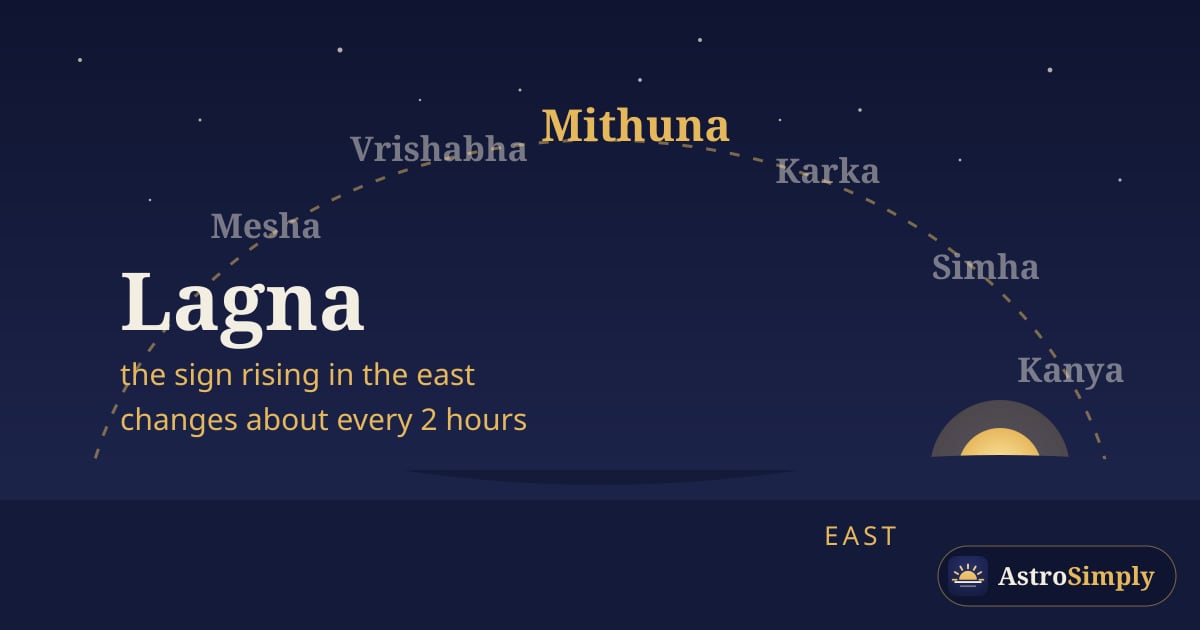
Lagna (ascendant): how it is found and why it changes everything
The lagna is the sign rising in the east when you were born. How it is calculated, how it differs from your rashi, what the lagna lord does, with an example.