Baby name by nakshatra: the 108 pada syllables and how to use them
How Namakaran picks a baby's first syllable from the Moon's nakshatra and pada. The full table of 108 letters, a worked example, regional customs, odd sounds.
Share these images
Send them to family and friends on WhatsApp, or save them to your phone.
In the Namakaran tradition a baby’s name begins with a sound chosen from the Moon’s position at birth: the nakshatra the Moon occupied, and the quarter (pada) of that nakshatra. Each of the 27 nakshatras has four padas, each with a syllable, 108 in all. Ashwini’s first pada gives “Chu”, its fourth “La”, Rohini’s second “Va”, and so on down the list.
That is the whole mechanism, and it is simpler than the hush around it suggests. What takes judgement is everything around it: finding the pada correctly when the birth was near a boundary, knowing that the tables differ in a few places, what regions do differently, and what to do when the prescribed sound is “Ng”. This post goes through all of it, with the complete table.
Why the Moon, and why a syllable?
The Moon in jyotish is the mind, the mother and the body’s comfort, and the nakshatra it occupied at birth, the janma nakshatra, is the most used point in Indian tradition: it decides the starting dasha, the muhurat for later ceremonies, and the name. A name is the sound a child hears most in life, and the old idea is that it should echo the sky the child arrived under. If you are new to all this, our plain-language guide to the kundali explains where the Moon and nakshatras sit in a chart.
Namakaran itself is one of the sixteen samskaras, placed on the 11th or 12th day after birth or on a convenient auspicious day after that; many homes combine it with the chhathi or barahi gathering. The pandit announces the nakshatra, the pada and its syllable, and the family chooses a name that starts with that sound. Whether that is the name used every day is a separate question, and we come to it.
Find the pada first
Each nakshatra spans 13°20′ of the zodiac, so a pada is 3°20′. The Moon covers roughly 13° a day, so it spends about six hours in a pada. A birth close to a pada boundary can therefore change syllable with a birth time wrong by twenty minutes, and the hospital’s recorded time is sometimes the first cry, sometimes the paperwork. Use the most reliable time you have, enter the place exactly, and if the Moon falls within the first or last few minutes of arc of a pada, tell your pandit; the honest practice is to acknowledge the uncertainty.
The free kundali in the app shows the Moon’s nakshatra, pada and degree directly: app.astrosimply.com/kundali.
The 108 syllables
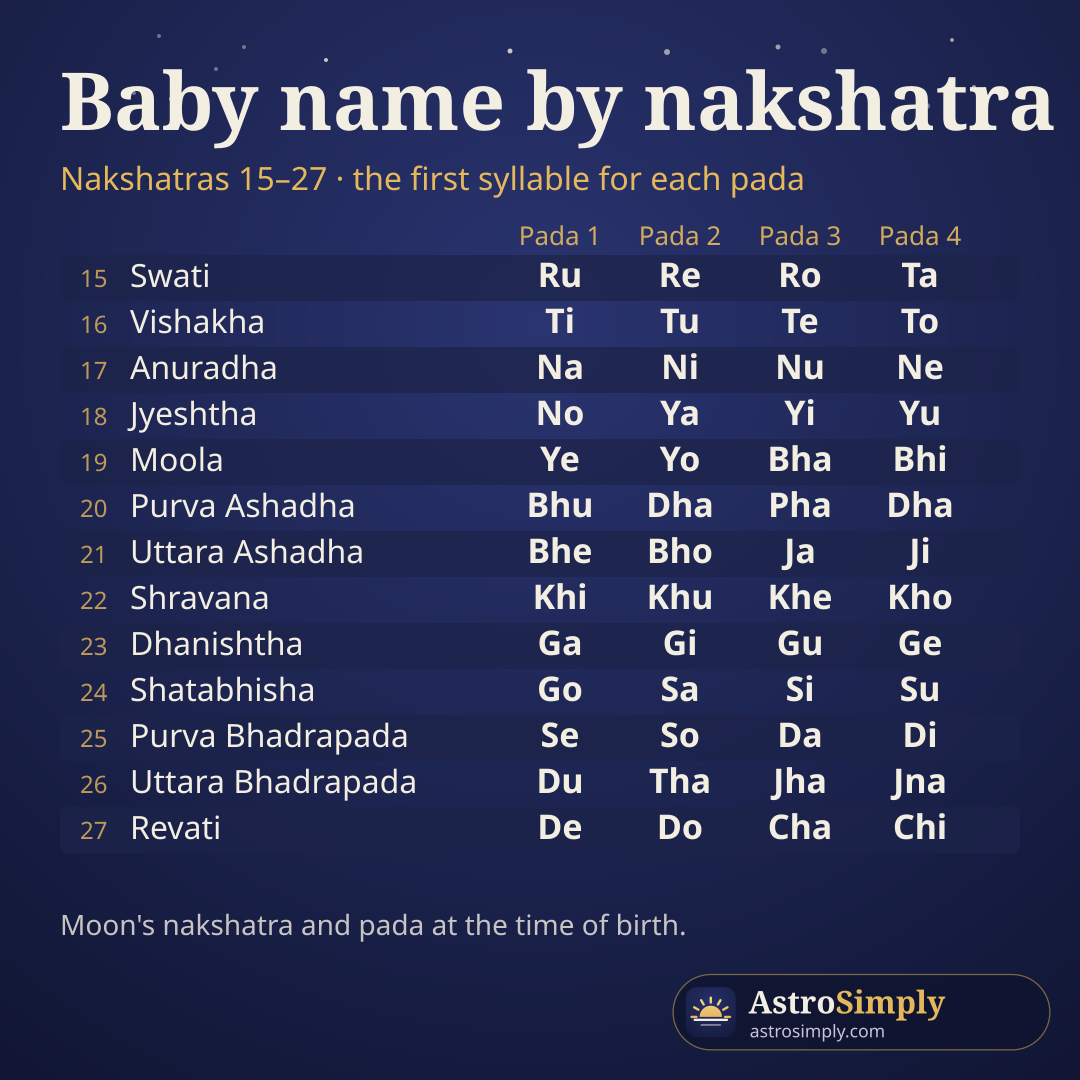
The table below is the common north Indian list, cross-checked across Dekho Panchang, Daanyam and VedicFeed, who agree on all but four cells, noted under the table.
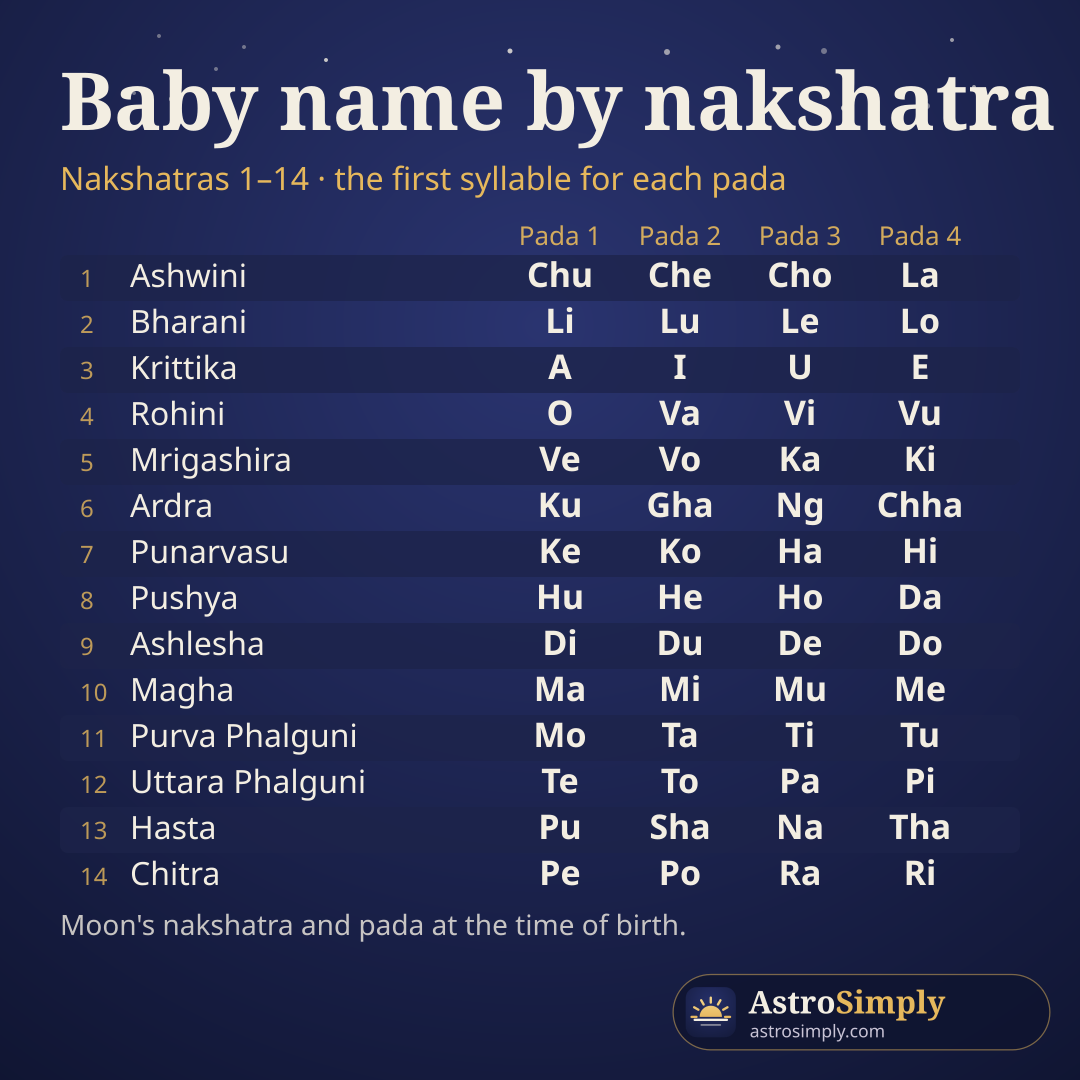
| # | Nakshatra | Pada 1 | Pada 2 | Pada 3 | Pada 4 |
|---|---|---|---|---|---|
| 1 | Ashwini | Chu | Che | Cho | La |
| 2 | Bharani | Li | Lu | Le | Lo |
| 3 | Krittika | A | I | U | E |
| 4 | Rohini | O | Va | Vi | Vu |
| 5 | Mrigashira | Ve | Vo | Ka | Ki |
| 6 | Ardra | Ku | Gha | Ng | Chha |
| 7 | Punarvasu | Ke | Ko | Ha | Hi |
| 8 | Pushya | Hu | He | Ho | Da |
| 9 | Ashlesha | Di | Du | De | Do |
| 10 | Magha | Ma | Mi | Mu | Me |
| 11 | Purva Phalguni | Mo | Ta | Ti | Tu |
| 12 | Uttara Phalguni | Te | To | Pa | Pi |
| 13 | Hasta | Pu | Sha | Na | Tha |
| 14 | Chitra | Pe | Po | Ra | Ri |
| 15 | Swati | Ru | Re | Ro | Ta |
| 16 | Vishakha | Ti | Tu | Te | To |
| 17 | Anuradha | Na | Ni | Nu | Ne |
| 18 | Jyeshtha | No | Ya | Yi | Yu |
| 19 | Moola | Ye | Yo | Bha | Bhi |
| 20 | Purva Ashadha | Bhu | Dha | Pha | Dha |
| 21 | Uttara Ashadha | Bhe | Bho | Ja | Ji |
| 22 | Shravana | Khi | Khu | Khe | Kho |
| 23 | Dhanishtha | Ga | Gi | Gu | Ge |
| 24 | Shatabhisha | Go | Sa | Si | Su |
| 25 | Purva Bhadrapada | Se | So | Da | Di |
| 26 | Uttara Bhadrapada | Du | Tha | Jha | Jna |
| 27 | Revati | De | Do | Cha | Chi |
Where the lists differ: for Shravana, some tables give “Ju, Je, Jo, Gha” instead of “Khi, Khu, Khe, Kho”; for Ardra’s third and fourth padas you will see “Ng” and “Chha” written various ways, and some panchangs give “Na” for the fourth; Uttara Bhadrapada’s fourth pada is the rare “Jna” (ज्ञ), and Uttara Ashadha’s first two are “Bhe, Bho” in most lists but “Be, Bo” in a few. These are families of tradition rather than errors; your pandit’s panchang is the authority for your family.
A transliteration point that trips up English-speaking parents: these are Devanagari sounds, not English spellings. Purva Phalguni’s “Ta, Ti, Tu” are the hard ट (as in Tina), while Swati’s “Ta” and Vishakha’s “Ti, Tu, Te, To” are the soft त (as in Tara). Listen for the sound, not the letter.
A worked example
A child is born on 12 August 1991 at 6:45 AM in Jodhpur. The chart puts the Moon at about 20° of Simha, in Purva Phalguni, third pada. The table gives “Ti” (टी). The family can look at names beginning with that sound: Tina, Tisha, Tirth and the like, and if none appeals, the other three padas of the same nakshatra give “Mo”, “Ta” and “Tu”. Had the child been born an hour and a half later, the Moon would have been at about 21°, still in the same pada; the boundary into the fourth pada (“Tu”) lies at 23°20′ of Simha, another five hours away. That margin is worth checking, which is why the app shows the degree next to the pada.
What families do in different regions
The syllable method is followed most literally in the Hindi belt, Gujarat, Maharashtra and Bengal, with differences in how the name is then used. In Maharashtra it is common to have a rashi naav, the nakshatra-based name used in rituals, and a separate haak naav that everyone actually calls the child. Bengali families similarly keep a bhalo naam for documents and a daak naam for home, and the nakshatra sound may live in either. In many Gujarati and north Indian families the pandit’s syllable is simply the first letter of the official name.
In the south the nakshatra matters as much, but naming often leans on the family deity, a grandparent’s name or the rashi rather than the pada syllable, and the janma nakshatra is used mainly for the annual nakshatra birthday and for muhurat. In Sikh families the first letter is traditionally taken from the hukamnama read at the gurdwara that day. None of these is more correct than another.
When the syllable is awkward
Parents in Ardra’s third pada or Uttara Bhadrapada’s fourth do not have to name a child “Ng” or “Jna”. The accepted options, in the order most pandits suggest them: another pada of the same nakshatra; the syllables of the Moon sign as a whole (for Mithuna, where Ardra falls, “Ka, Ki, Ku, Gha, Ng, Chha, Ke, Ko, Ha”); and finally keeping the nakshatra sound as a middle name or as the guhya naam, the ritual name used in the sankalpa at pujas, while the everyday name is chosen freely. Many families also hold that the nakshatra name need not be told to everyone; there is an old sense that it belongs to the child and the family.
One more case: a Moon in the junction nakshatras, Ashwini, Magha, Moola, Ashlesha, Jyeshtha or Revati, near the boundary between a water sign and a fire sign. Families often take extra care here, and some prefer the lagna nakshatra’s syllable. We wrote about this in Born in Moola nakshatra; the short version is that it calls for a correct chart and a calm pandit, not alarm.
The common misunderstanding
The error we see most is working backwards: taking the first letter of a name someone already likes and declaring the child’s rashi from it. That naam rashi convention exists, for matching and muhurat when the birth time is simply not known. But if the birth time is known, the Moon decides the rashi and nakshatra, not the name, and a name starting with another letter changes nothing in the chart. Take the syllable from the chart, by all means; just do not let the name redefine the chart.
If you would like a newborn’s nakshatra, pada and dasha written out and checked by a pandit before the ceremony, the verified kundali report is ₹199 as a PDF or ₹499 printed and delivered: astrosimply.com/shop/#reports. The nakshatra and pada themselves you can see free in the app today.
Frequently asked questions
Does the name have to start with the exact syllable, or just the letter?
Traditionally the sound, vowel included: “Chu” is चु, not just “Ch”. In practice most families keep the consonant and accept any vowel, and most pandits are relaxed about it. Where the family is strict, the other three padas give three more sounds to choose from.
We named the baby before checking the nakshatra. Is that a problem?
No. The chart is what it is, and a name does not alter it. Many families then give a short nakshatra name for rituals, or simply note the syllable and move on.
Which nakshatra do we use if the baby was born at night, after midnight?
The Moon’s nakshatra at the clock time of birth, on that calendar date. The Hindu day runs from sunrise to sunrise, which matters for the tithi and vaar (weekday) of the birth, but the nakshatra is simply where the Moon was at that moment. Enter the date and time as the hospital recorded them.