Karwa Chauth 2026: moonrise time city by city and the puja muhurat
Karwa Chauth 2026 is on Thursday 29 October. Moonrise and puja timings for ten cities, why the moon rises late, the day's panchang, and wishes to share.
Share these images
Send them to family and friends on WhatsApp, or save them to your phone.
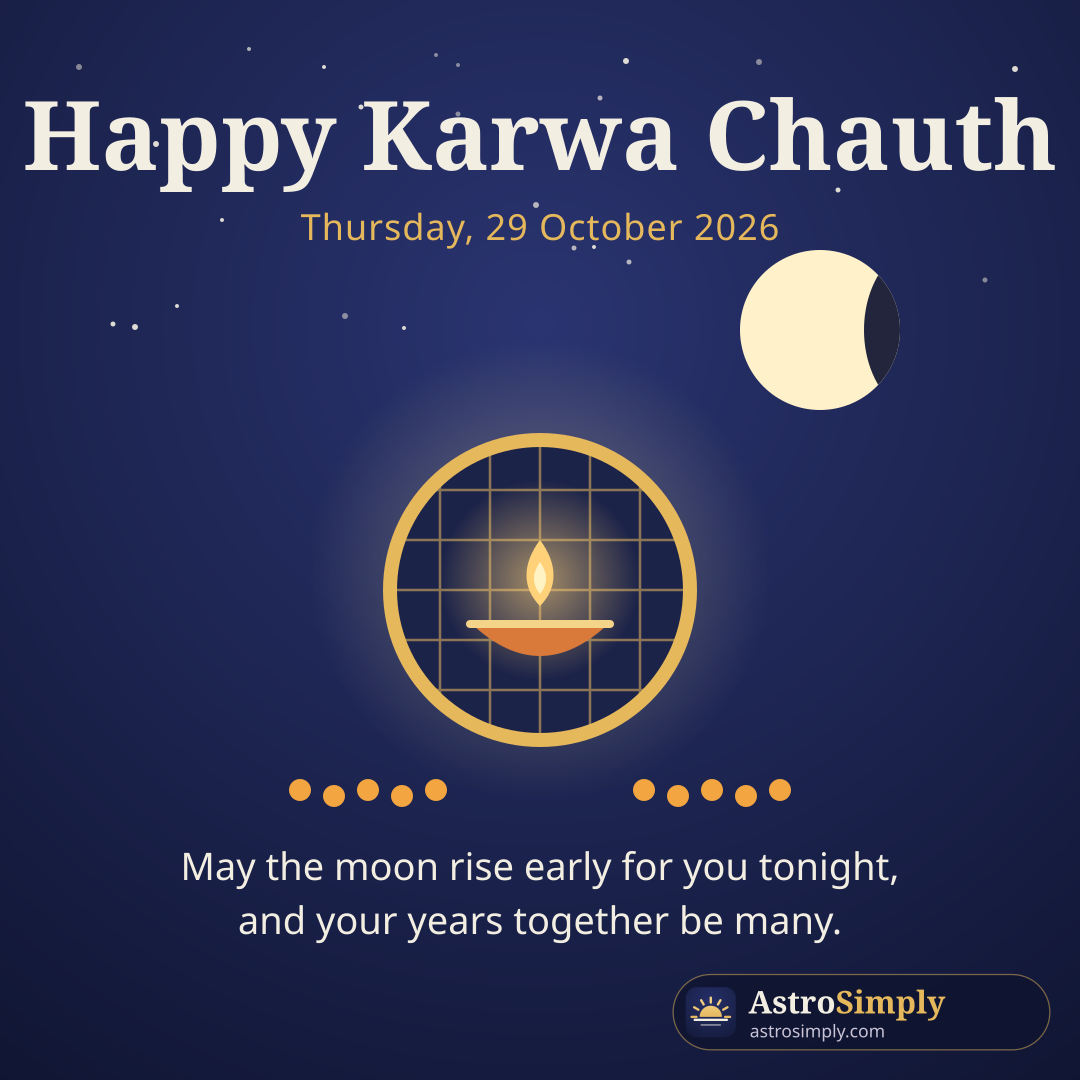
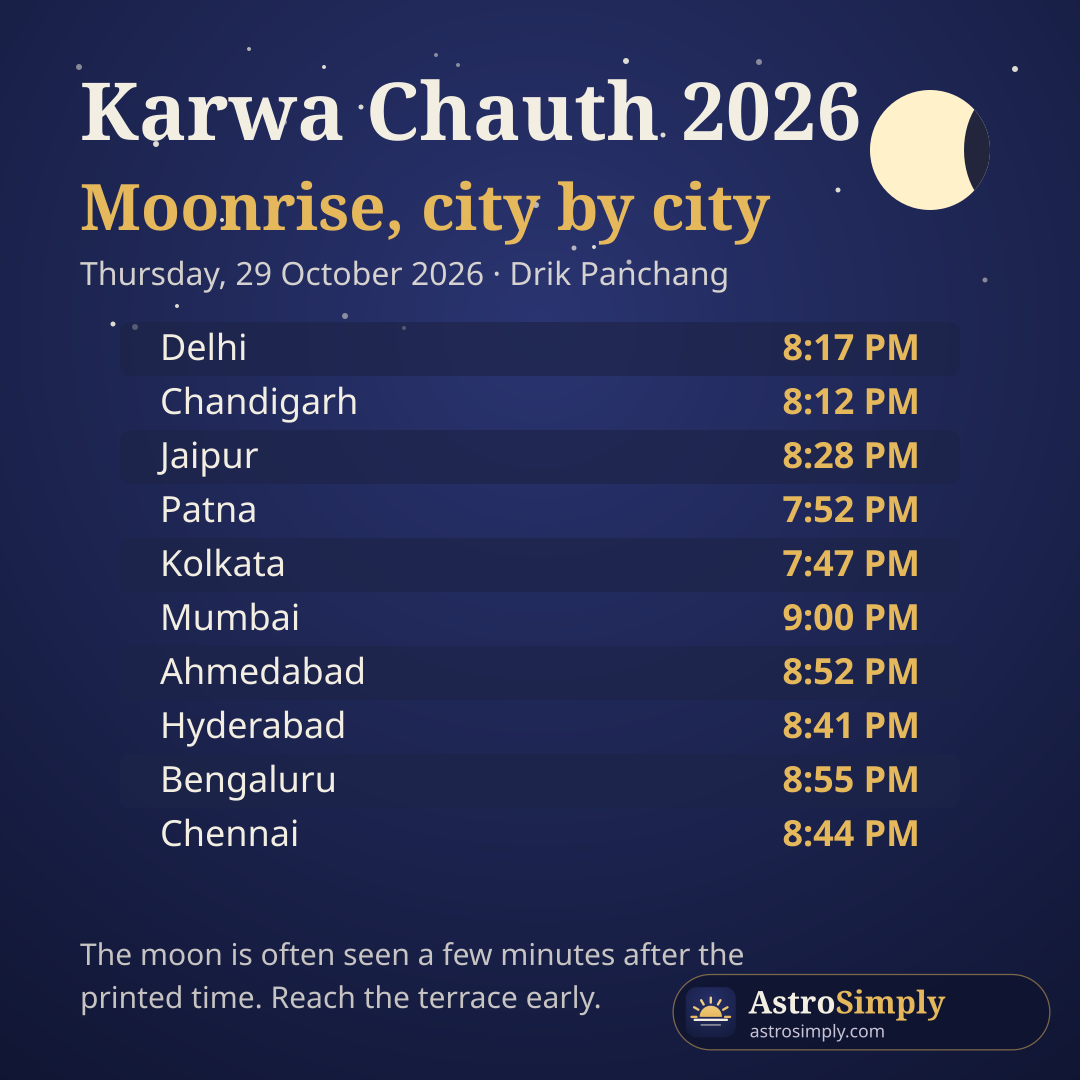
Karwa Chauth 2026 falls on Thursday, 29 October. In Delhi the moon is expected at 8:17 PM, and the evening puja window runs from 5:38 PM to 6:56 PM. Drik Panchang, Dainik Jagran and India TV all give the same date and the same Delhi timings, so there is no confusion this year about the 29th versus the 30th.
The moon, as every year, keeps its own schedule. Kolkata sees it before half past seven; Mumbai waits until nine. Below is the city table, the reason the Karwa Chauth moon always rises so late, what the panchang of the day looks like, and a few wishes you can send in the morning.
When does the moon rise in your city?
These are Drik Panchang’s figures for 29 October 2026. The puja muhurat is the window after sunset for the evening katha and the thali ritual; the moonrise is when the fast is broken.
| City | Puja muhurat | Moonrise |
|---|---|---|
| Delhi | 5:38 – 6:56 PM | 8:17 PM |
| Chandigarh | 5:38 – 6:55 PM | 8:12 PM |
| Jaipur | 5:46 – 7:03 PM | 8:28 PM |
| Patna | 5:10 – 6:27 PM | 7:52 PM |
| Kolkata | 5:01 – 6:17 PM | 7:47 PM |
| Mumbai | 6:07 – 7:22 PM | 9:00 PM |
| Ahmedabad | 6:04 – 7:20 PM | 8:52 PM |
| Hyderabad | 5:46 – 7:01 PM | 8:41 PM |
| Bengaluru | 5:54 – 7:08 PM | 8:55 PM |
| Chennai | 5:43 – 6:57 PM | 8:44 PM |
Two things to know about these numbers. First, the east sees the moon earlier than the west, which is why Patna is forty minutes ahead of Jaipur and more than an hour ahead of Mumbai: the moon rises in the east, and eastern cities simply turn to face it first. Second, calendars differ by a few minutes. PanchangBodh publishes a geometric moonrise list that runs about five minutes earlier than Drik Panchang for every city, because it does not allow for the horizon. In practice the moon in a city is often seen a little after the printed time, behind haze or buildings, never before it. Treat the time as the earliest you should expect, and get to the terrace ten minutes early.
If your town is not in the table, the panchang in the AstroSimply app gives moonrise for your own city: app.astrosimply.com/panchang.
Why does the Karwa Chauth moon rise so late?
Karwa Chauth is kept on Chaturthi, the fourth tithi of the dark fortnight of Kartik (in the Amanta calendar used in Gujarat, Maharashtra and the south, the same day is counted in Ashwin; the day itself is the same everywhere). The dark fortnight begins after the full moon, and each day the moon rises roughly fifty minutes later than the day before. Four days after Purnima it is rising about three hours after sunset, with a visible bite taken out of its right side. That is the moon of Karwa Chauth: not full, not thin, a generous waning moon that comes up well into the night.
This is also why the same evening is Sankashti Chaturthi, the monthly fast for Ganesh ji that is broken on the sight of the moon. In Maharashtra and many other homes that fast is kept on this very day by men and women alike, which makes 29 October a moon-watching evening for far more families than the Karwa Chauth tradition alone.
The panchang of the day
For Delhi, Drik Panchang lists the Chaturthi tithi from 1:06 AM to 10:09 PM on 29 October, so it covers the whole day and the whole evening ritual. Sunrise is at 6:31 AM and sunset at 5:38 PM; the fast therefore runs from 6:31 AM to moonrise, a little under fourteen hours in Delhi and a little over fourteen in Mumbai.
The nakshatra is Rohini until 11:11 AM, then Mrigashira. The Moon itself sits in Vrishabha, its sign of exaltation, until 10:06 PM. In jyotish the Moon is at its happiest in Vrishabha and in Rohini, which the tradition calls the Moon’s favourite nakshatra. So the moon that rises on this Karwa Chauth is an exalted Moon, rising in Mrigashira only hours after leaving Rohini. Pandits like to point this out because the evening is, after all, a prayer offered to the Moon. Rahu kaal in Delhi is 1:28 PM to 2:52 PM, which does not touch the puja or the moonrise; Abhijit muhurat is 11:42 AM to 12:27 PM if you want to set out the puja thali in the morning.
How the day goes in most homes
The customs below are the common north Indian pattern, kept most widely in Punjab, Haryana, Delhi, Uttar Pradesh, Rajasthan, Himachal and Madhya Pradesh. Families everywhere add their own touches, and that is as it should be.
Sargi before dawn. The mother-in-law sends or prepares a small meal, the sargi, which is eaten before sunrise: fruit, dry fruit, sweets, seviyan or pheni, water. After sunrise nothing is taken until the moon is seen. Many families where the mother-in-law is far away now send the sargi as a parcel a day or two before, and the morning call stands in for her presence.
The day. Hands are decorated with mehndi the evening before. The vrat is traditionally nirjala, without water, but it has always been understood as devotion, not endurance. Anyone who is unwell, expecting, elderly or on medicines keeps the spirit of the day with fruit and water, and no tradition faults them for it.
The evening katha. In the puja muhurat the women of a neighbourhood sit together in a circle, each with a decorated thali and a karwa, the small earthen pot that gives the day its name (karwa, the pot; chauth, the fourth). The vrat katha is read, usually the story of Veeravati and her seven brothers, and in many families the story of Savitri is told alongside it. The thalis are passed around the circle during the katha, a custom known as thali pherna. The karwas are exchanged, and gifts called baya go from the daughter-in-law’s side to the mother-in-law.
Moonrise. When the moon is seen, the woman looks at it through a chhalni, a sieve, with a lit diya held in the sieve, offers arghya (water) to the moon, then looks at her husband through the same sieve. He offers her the first sip of water and a bite of sweet, and the fast ends. Then everyone eats. The older meaning of the sieve is simple: the moon is seen first, the beloved next, both through the same light.
In Rajasthan, parts of Uttar Pradesh and some other regions unmarried women also keep the fast, praying for a good match, and in those families the moon rite is done facing the moon alone. Some communities break the fast on seeing the moon’s reflection in a bowl of water if the sky is clouded; others wait. Both are accepted.
A note for first-timers and for husbands
Lay out the thali in the afternoon: a diya, incense, kumkum, rice, flowers, a sweet, a glass of water and the karwa, filled with water and often a few grains and a coin. Keep the sieve near the door. Husbands: the moon does not wait for a video call to connect, so be on the terrace before the printed time, with the water glass. In many Punjabi families the husband now keeps the fast too; nothing in the tradition forbids it.
If you are putting together a puja thali, the AstroSimply shop lists puja items delivered across India: astrosimply.com/shop/#puja.
Wishes you can send on the morning of Karwa Chauth
Copy one, or let it start your own.
- Happy Karwa Chauth. May the moon rise early for you tonight and may every year bring you more to be thankful for together.
- To the one who keeps the fast and the one who brings the water: may your home always have this much love in it. Happy Karwa Chauth.
- May your mehndi be dark, your moon be on time, and your years together be many. Karwa Chauth ki shubhkamnayein.
- To my mother-in-law: thank you for the sargi and for everything before it. Happy Karwa Chauth.
The greeting cards under this post can be shared directly to WhatsApp.
Frequently asked questions
Is Karwa Chauth on 29 or 30 October in 2026?
It is Thursday, 29 October. The Chaturthi tithi runs from 1:06 AM to 10:09 PM on the 29th, so it covers both the evening puja and the moonrise. On the 30th the tithi is already over before sunrise. Every calendar we checked agrees.
What if it is cloudy and the moon cannot be seen?
Tradition offers a few ways out. Wait a reasonable time after the printed moonrise; the moon is often visible through thin cloud. If it is not, many families offer arghya in the direction of the moon at the published time, or to the moon’s reflection in a bowl of water, and break the fast. Ask the elders in your family which they follow; no option is wrong.
Can I check moonrise for a small town?
Yes. Moonrise depends on your exact location, so a town two hundred kilometres east of Delhi sees the moon ten to fifteen minutes earlier. The panchang in the app shows moonrise, sunrise, sunset and the day’s tithi for any city or town you choose, in Hindi or English.
Sources
- Drik Panchang – Karwa Chauth 2026 date, puja muhurat and moonrise, New Delhi
- Drik Panchang – Panchang for 29 October 2026, New Delhi
- Dainik Jagran – Karwa Chauth 2026 date, puja muhurat and city-wise moonrise
- PanchangBodh – Karwa Chauth 2026 moonrise time for 40 Indian cities
- India TV – Karwa Chauth 2026 date, timings and fasting rules
Read next

Diwali 2026 Lakshmi Puja muhurat: why Pradosh kaal and a fixed lagna
Diwali 2026 is on Sunday 8 November. The Lakshmi Puja window, city by city, how the muhurat is worked out from Amavasya tithi, Pradosh kaal and a fixed lagna.
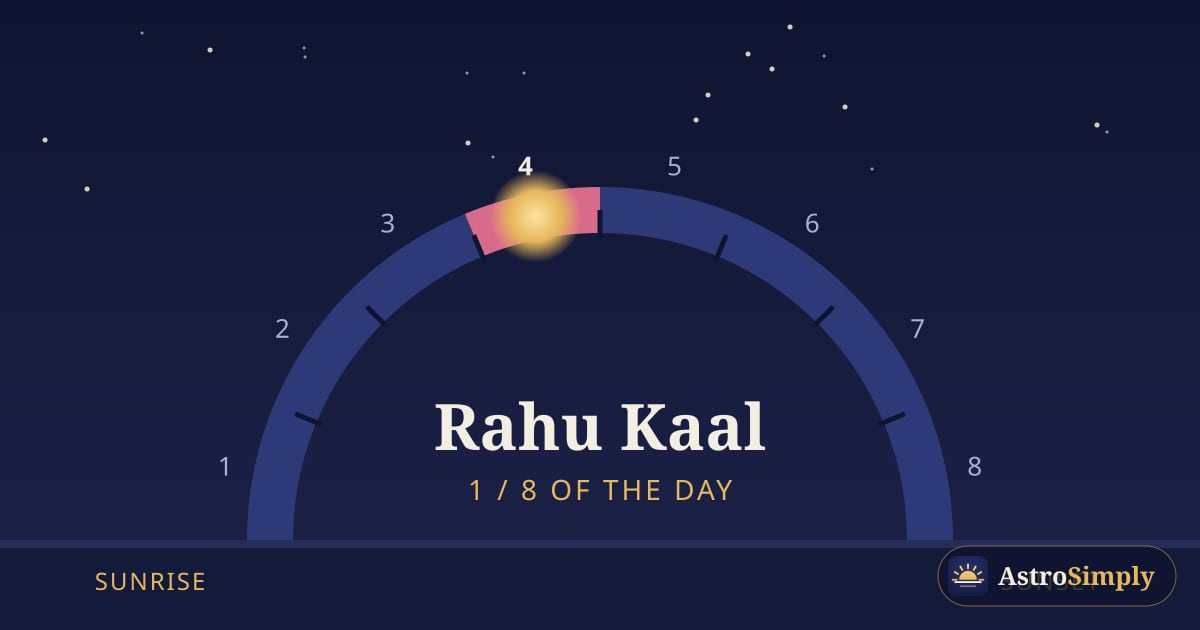
Rahu kaal: how it is calculated for your city, and what it is for
Rahu kaal is one eighth of the daylight, chosen by the weekday. The arithmetic with a real day, the weekday table, where it comes from, what it doesn't stop.
Ravi Pushya on 1 November 2026: the shopping day before Dhanteras
Ravi Pushya yoga falls on Sunday 1 November 2026, five days before Dhanteras. The window, the best Choghadiya, Rahu kaal to skip, and what people buy.