Rahu kaal: how it is calculated for your city, and what it is for
Rahu kaal is one eighth of the daylight, chosen by the weekday. The arithmetic with a real day, the weekday table, where it comes from, what it doesn't stop.
Share these images
Send them to family and friends on WhatsApp, or save them to your phone.
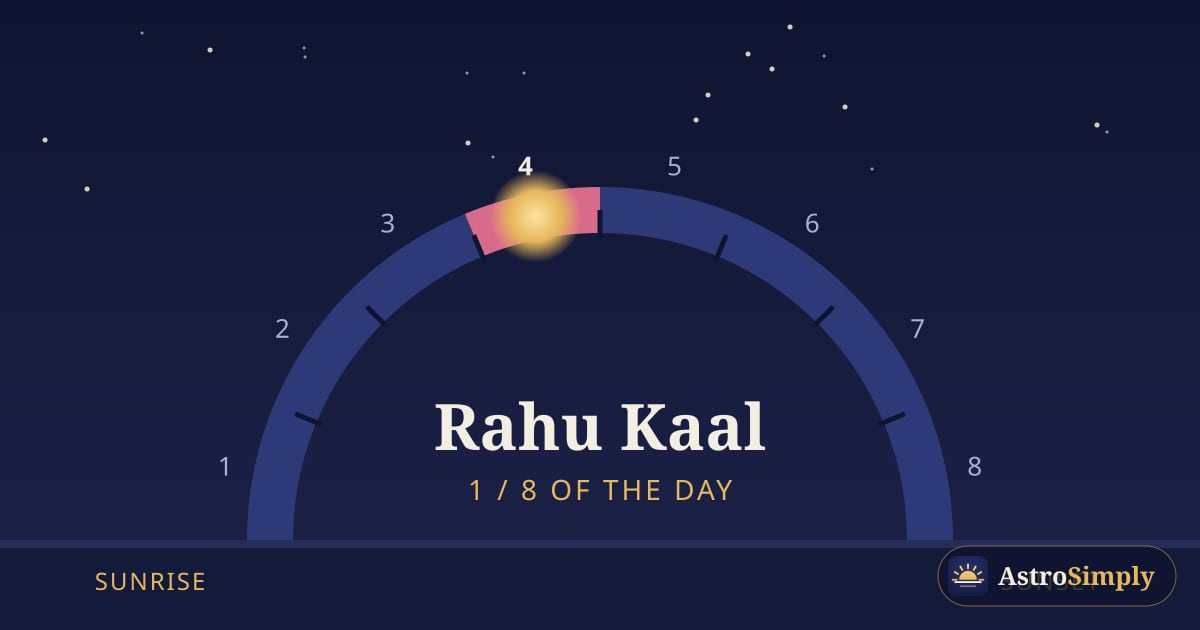
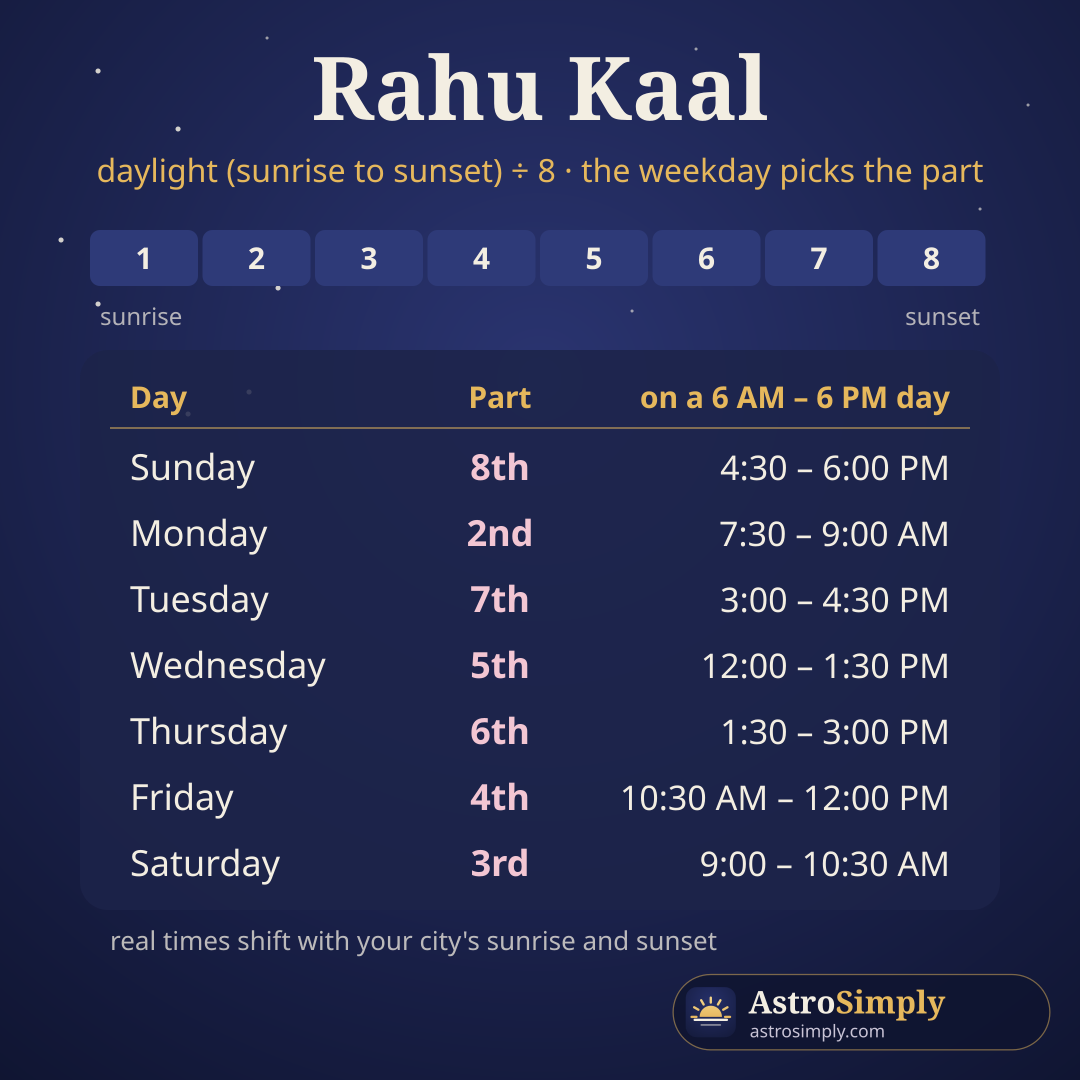
Rahu kaal is one eighth of the daylight on any given day, and which eighth depends on the weekday: the second part on Monday, the seventh on Tuesday, the fifth on Wednesday, the sixth on Thursday, the fourth on Friday, the third on Saturday and the last on Sunday. Because it is a fraction of the time between your own sunrise and sunset, it moves with the seasons and differs from one city to the next, which is why the “7:30 to 9:00 on Monday” table pinned up in so many shops is only ever roughly right.
That is the whole mechanism. Below is the arithmetic with a real day, the weekday table you can save, where the practice comes from, what it is and isn’t meant to stop you doing, and the misunderstandings that cause the most needless worry.
The calculation, with a real Delhi day
Take Friday 30 October 2026 in Delhi. Drik Panchang lists sunrise at 6:31 AM and sunset at 5:38 PM.
- Daylight: 6:31 AM to 5:38 PM is 11 hours 7 minutes, or 667 minutes.
- One eighth: 667 ÷ 8 is about 83 minutes, call it 1 hour 23 minutes.
- Friday takes the fourth part, so Rahu kaal begins three parts after sunrise: 6:31 AM plus 3 × 83 minutes is 10:41 AM, and it ends one part later at 12:05 PM.
Drik Panchang’s figure for that day is 10:41 AM to 12:05 PM, exactly this. Do it for Mumbai, where the sun rises and sets later, and the window moves later by about a quarter of an hour; do it in June, when daylight is nearly fourteen hours, and each part grows past 100 minutes. Short winter days give a short Rahu kaal, long summer days a long one.
The weekday table
| Day | Part of the day | Rough clock time (6 AM – 6 PM day) |
|---|---|---|
| Sunday | 8th | 4:30 – 6:00 PM |
| Monday | 2nd | 7:30 – 9:00 AM |
| Tuesday | 7th | 3:00 – 4:30 PM |
| Wednesday | 5th | 12:00 – 1:30 PM |
| Thursday | 6th | 1:30 – 3:00 PM |
| Friday | 4th | 10:30 AM – 12:00 PM |
| Saturday | 3rd | 9:00 – 10:30 AM |
The third column is the version people memorise, and it is exactly right only on a day when the sun rises at six and sets at six, which happens near the equinoxes in the south of India and almost never in Delhi. The first part of the day, just after sunrise, is never Rahu kaal on any weekday, which is one reason early-morning pujas and departures are traditional. The panchang in the AstroSimply app does the sum for your own city every day: app.astrosimply.com/panchang.
Where the practice comes from
Rahu kaal belongs to muhurta, the branch of jyotish that chooses times, not to the reading of birth charts; you will not find it in Parashara’s Hora Shastra, and it has nothing to do with where Rahu sits in your own kundali. It comes down through the panchang tradition, where the daylight is divided into eight parts and three of them are set aside and named for Rahu, for Gulika (also called Mandi, the son of Saturn) and for Yama (Yamaganda). On the same Friday Drik Panchang lists Gulika kaal at 7:55 to 9:18 AM and Yamaganda at 2:51 to 4:14 PM, each one part long. Rahu kaal is simply the one of the three that has travelled furthest in popular use.
It has always been observed most strictly in Tamil Nadu, Karnataka, Andhra, Telangana and Kerala, where a wedding card states the muhurtam and a shopkeeper will not open a new ledger in Rahu kalam. In the north the Choghadiya table has historically been the everyday tool and Rahu kaal a second check, though television panchangs have now made it familiar everywhere. Neither region is “right”; they are two ways of doing the same careful thing.
What it is meant for, and what it isn’t
The rule is narrow: do not begin something new and auspicious in Rahu kaal. The usual list is a wedding or engagement ceremony, griha pravesh, the first entry in a new account book, opening a shop, setting out on a long journey, signing a big agreement, or starting a puja or havan for a benefic planet. Beginnings, in other words.
Everything else goes on. Eating, sleeping, routine office work, a meeting someone else fixed, a journey already under way, a class, a flight, an interview whose time you did not choose: none of these are “in” Rahu kaal in any sense the tradition recognises, because you did not initiate them in that window. Work started before Rahu kaal is not harmed by continuing through it. And the tradition makes one deliberate exception: worship addressed to Rahu himself, and in the Tamil tradition the Rahu kala Durga puja held in many temples on Tuesdays and Fridays, is placed in his hour on purpose.
A worked example
Meera in Coimbatore wants to open the new account books for her tailoring shop on a Monday in early November. Monday’s Rahu kaal is the second part of the day, which in Coimbatore at that time of year works out to roughly 7:45 to 9:10 AM. She has two good choices: light the lamp and make the first entry at 7:00, before Rahu kaal starts, or wait until after 9:10. She picks 9:30, after Rahu kaal and inside a Labha Choghadiya. A customer who walks in at 8:00 while she is setting up is not a problem; the muhurat was for the first entry, not for the shutter.
Three misunderstandings that cause needless worry
“My child was born in Rahu kaal.” This is the one that frightens people, and it should not. Rahu kaal is a muhurta rule for choosing a time; it says nothing about a birth, which no one chooses. A child’s chart is read from the lagna, the Moon, the nakshatra and the dashas, as our guide to the kundali explains: /blog/what-is-a-kundali/. Rahu kaal does not appear in it.
“Rahu kaal is the same every Monday.” Only on the printed poster. In Delhi the Monday window is about 7:55 to 9:20 AM in late October and about 6:55 to 8:25 AM in June. Use the day’s panchang, not the poster.
“Something started in Rahu kaal will fail.” The tradition says the time is unfavourable for beginnings, which is a reason to prefer another hour when you have the choice. It is not a verdict on what you could not avoid. If a job offer came in Rahu kaal, take the job.
The courteous way to use Rahu kaal is the way a good pandit does: as one line in the panchang, checked along with the tithi, the nakshatra and the Choghadiya when a date is being fixed, and otherwise left alone. For a wedding or griha pravesh date, the muhurat finder in the app weighs all of these for your city and chart: app.astrosimply.com/muhurat.
Frequently asked questions
Is there a Rahu kaal at night?
A night Rahu kaal can be computed the same way, dividing sunset to the next sunrise into eight parts, and some panchangs print it. It is far less observed; Drik Panchang calls it the less popular version, and most families consider only the daytime one.
Which weekday’s Rahu kaal matters most?
Some panchangs single out Tuesday, Friday and Sunday as the days on which Rahu kaal is observed most strictly, which is why those three come up in the south for Rahu-related worship. In practice most people apply the same rule on all seven days.
Do I need to avoid Rahu kaal for a puja at home?
Daily puja, no; it is not a new beginning. For starting a new vrat, a havan for a benefic planet, or the first day of a special observance, people choose a time outside it. Worship of Rahu, and the Rahu kala Durga puja of the Tamil tradition, is deliberately placed inside it.
Sources
Read next
Karwa Chauth 2026: moonrise time city by city and the puja muhurat
Karwa Chauth 2026 is on Thursday 29 October. Moonrise and puja timings for ten cities, why the moon rises late, the day's panchang, and wishes to share.

Diwali 2026 Lakshmi Puja muhurat: why Pradosh kaal and a fixed lagna
Diwali 2026 is on Sunday 8 November. The Lakshmi Puja window, city by city, how the muhurat is worked out from Amavasya tithi, Pradosh kaal and a fixed lagna.
What is a kundali? A plain-language guide to your birth chart
Lagna, houses, grahas and nakshatras — what a Vedic birth chart actually contains, why birth time matters, and what a kundali can and cannot tell you.