Diwali 2026 Lakshmi Puja muhurat: why Pradosh kaal and a fixed lagna
Diwali 2026 is on Sunday 8 November. The Lakshmi Puja window, city by city, how the muhurat is worked out from Amavasya tithi, Pradosh kaal and a fixed lagna.

Share these images
Send them to family and friends on WhatsApp, or save them to your phone.
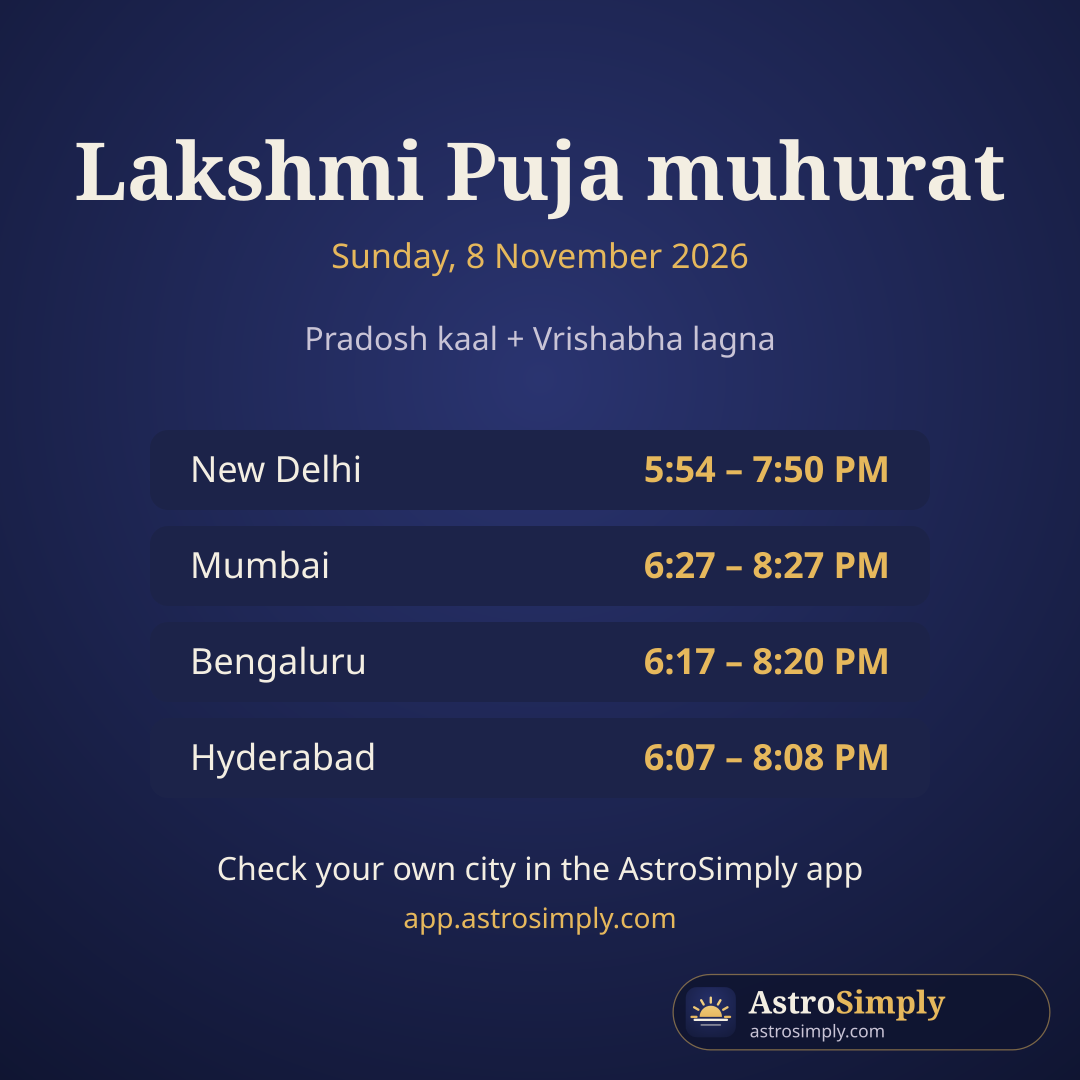
Diwali, with the main Lakshmi Puja, falls on Sunday, 8 November 2026 across India. Drik Panchang, Shubh Panchang and AstroMedha all agree on the date. The puja itself belongs to the evening: in New Delhi the recommended window is 5:54 PM to 7:50 PM, when Pradosh kaal and the fixed sign Vrishabha rising overlap. Other cities shift by half an hour or so, and we list several below.
The more interesting question, and the one most families never ask their pandit, is why this particular window. Once you see how the muhurat is built from three ingredients, you can check it yourself for any town, and you will understand why your cousin in Guwahati lights the lamp earlier than you do in Mumbai.
The three ingredients of the Diwali muhurat
Ingredient one: Amavasya tithi must be present at dusk
Diwali is tied to Kartik Amavasya, the new Moon of the month of Kartik. A tithi does not run from midnight to midnight; it is a fixed angular distance between the Sun and the Moon, so it starts and ends at odd clock times. In 2026, Amavasya begins at 11:27 AM on 8 November and ends at 12:31 PM on 9 November.
The rule for Diwali is that Amavasya should prevail during Pradosh kaal, the stretch just after sunset. On 8 November it does. On 9 November Amavasya ends at lunchtime, long before evening. That settles the date even though Amavasya technically touches both days. Some calendars list 9 November for the morning rites of Diwali Snan and Devpuja for the same reason: Amavasya still rules that sunrise.
Ingredient two: Pradosh kaal
Pradosh means the time just after sunset, traditionally reckoned as roughly two and a half hours from sundown. For New Delhi on 8 November Drik Panchang gives Pradosh kaal as 5:31 PM to 8:09 PM. This is considered the natural hour for Lakshmi, who is invited into a lit and cleaned home as darkness falls. Drik Panchang says plainly that for householders it proposes the Pradosh kaal muhurat, and advises against using Choghadiya tables for this puja, since those are meant for travel and routine work.
Ingredient three: a sthir lagna
Within Pradosh kaal, the tradition prefers a sthir (fixed) lagna, one of the four fixed signs rising on the eastern horizon: Vrishabha, Simha, Vrishchika or Kumbha. The logic, as Drik Panchang puts it, is that Lakshmi invited during a fixed sign stays in the home. In early November the Sun is in Tula, so Vrishabha, which is opposite Tula, rises in the early evening and conveniently sits inside Pradosh kaal. In New Delhi on 8 November, Vrishabha lagna runs 5:54 PM to 7:50 PM, and that overlap is the Lakshmi Puja muhurat.
Put the three together and the arithmetic is obvious: Amavasya is present, Pradosh kaal is 5:31 to 8:09, Vrishabha rises 5:54 to 7:50, so the muhurat is 5:54 to 7:50.
City-wise Lakshmi Puja muhurat for 8 November 2026
Sunset and the rising sign depend on where you stand, so the window moves. These are the windows Drik Panchang publishes for each city.
| City | Lakshmi Puja muhurat (Vrishabha lagna in Pradosh kaal) |
|---|---|
| New Delhi | 5:54 PM to 7:50 PM |
| Mumbai | 6:27 PM to 8:27 PM |
| Bengaluru | 6:17 PM to 8:20 PM |
| Hyderabad | 6:07 PM to 8:08 PM |
| Hajo (Assam) | 5:01 PM to 6:58 PM |
Shubh Panchang gives 6:29 PM to 8:29 PM without naming a city, which matches the Mumbai figure closely. The lesson is that any muhurat you read online should name the city. If it does not, treat it as approximate and look up your own town — the AstroSimply panchang shows today’s tithi, sunset and Abhijit muhurat for any city you pick.
Eastern India lights lamps a good hour before the west, because the Sun sets earlier there. A family in Assam that waits for a Delhi timing they saw on television will miss their own window entirely.
What about Mahanishita kaal?
You may see a second, late-night window called Mahanishita kaal, which for New Delhi is 11:39 PM to 12:31 AM on the night of 8 to 9 November. This falls when Simha, another fixed sign, rises. It is a genuine muhurat, but Drik Panchang’s view, and ours, is that it suits tantric practitioners and pandits who keep that routine. A household with children and elders should use the evening window. There is no extra merit in staying up.
The five days around Diwali in 2026
Drik Panchang’s Diwali calendar for 2026 (New Delhi) lists the surrounding days as follows.
| Date | Observance |
|---|---|
| Thursday 5 November | Govatsa Dwadashi (Vasu Baras) |
| Friday 6 November | Dhanteras (Dhantrayodashi), Yama Deepam |
| Saturday 7 November | Kali Chaudas, Hanuman Puja |
| Sunday 8 November | Narak Chaturdashi (Abhyang Snan), Lakshmi Puja, Kali Puja, Chopda Puja |
| Monday 9 November | Diwali Snan, Diwali Devpuja |
| Tuesday 10 November | Govardhan Puja (Annakut), Bali Pratipada, Gujarati New Year |
| Wednesday 11 November | Bhai Dooj (Yama Dwitiya), Chitragupta Puja |
One point where sources differ: Drik Panchang places Narak Chaturdashi, popularly Choti Diwali, on the morning of 8 November, because Chaturdashi tithi is present at that sunrise and the Abhyang Snan is a pre-dawn rite; the previous evening, 7 November, is listed as Kali Chaudas. AstroMedha simply gives 7 November for Naraka Chaturdashi. Both are describing the same Chaturdashi tithi, which starts on the 7th and runs into the morning of the 8th. If your family’s custom is the evening lamps of Choti Diwali, that is 7 November; if it is the early-morning oil bath, that is 8 November.
Dhanteras on Friday 6 November, Govardhan Puja on Tuesday 10 November and Bhai Dooj on Wednesday 11 November are agreed by the sources we checked.
A worked example: setting the time for a family in Jaipur
Suppose a joint family in Jaipur wants to fix the puja so that the working members can be home. Jaipur is slightly west of Delhi, so everything happens a few minutes later. They look up the Jaipur page of a panchang and find Pradosh kaal starting around a quarter to six and Vrishabha lagna a little after six, ending a few minutes before eight. They choose to begin the Ganesh-Lakshmi puja at 6:30 PM, which leaves an hour of Vrishabha lagna for the sankalp, the main puja and the aarti. The lamps for the whole house can be lit from sunset onward; only the formal invocation needs to fall inside the fixed lagna. That is a far more relaxed plan than racing to start at the first minute.
What to ask your pandit
- “Is the muhurat you gave me for our city, or a general one?”
- “Are you using Vrishabha lagna in Pradosh kaal, or a Choghadiya?” A pandit using Choghadiya for Lakshmi Puja is following a shortcut, not the tradition.
- “If we cannot start in the window, which part must fall inside it?” Most will say the sankalp and the main invocation.
The AstroSimply app’s panchang screen shows the tithi and the sunset time for your own location, which gives you the start of Pradosh kaal for your town rather than a timing meant for another city.
A common misunderstanding
People often think that if the puja cannot start inside the muhurat, the whole evening is spoilt. It is not. The muhurat marks the best overlap, not a gate that slams shut. Pradosh kaal in New Delhi runs until 8:09 PM, so a late start is still within an auspicious period, just outside the fixed-lagna refinement. A puja done with attention at 8:00 PM is worth more than one rushed at 5:54 with the family still arriving.
Frequently asked questions
Why is Diwali on 8 November and not 9 November, when Amavasya continues into the 9th?
Because the festival is defined by Amavasya at Pradosh kaal, the evening. On the 8th Amavasya begins at 11:27 AM and covers the whole evening. On the 9th it ends at 12:31 PM, so that evening is Pratipada, not Amavasya. Morning observances tied to Amavasya, such as Diwali Snan, do fall on the 9th.
Is the Lakshmi Puja timing different for people outside India?
Yes, and sometimes by a full day. Drik Panchang’s listing for Manassas, Virginia, shows Amavasya beginning at 12:57 AM on 8 November local time, and notes that the Diwali date abroad can be a day ahead of India’s. Always use a panchang set to your own city rather than converting Indian timings.
Do we need a priest for Lakshmi Puja?
No. Lakshmi Puja is one of the most common household rites in India, performed by the family itself in most homes. A clean altar, a lamp, flowers, sweets, the family’s account books or valuables if that is your custom, and the Lakshmi and Ganesh aarti are enough. A pandit adds the Vedic mantras, which is welcome but not required.
For your own city and family: check the panchang for your town in the AstroSimply app (free), or, if you would like a pandit to talk you through the puja timing for your family, book a 1-hour consultation with our expert pandit ji on WhatsApp and phone. Planning other ceremonies this season? The muhurat finder suggests good dates for your city, and our post on Jupiter entering Simha covers the big transit of the month.
Sources
Read next

Ravi Pushya on 1 November 2026: the shopping day before Dhanteras
Ravi Pushya yoga falls on Sunday 1 November 2026, five days before Dhanteras. The window, the best Choghadiya, Rahu kaal to skip, and what people buy.
Karwa Chauth 2026: moonrise time city by city and the puja muhurat
Karwa Chauth 2026 is on Thursday 29 October. Moonrise and puja timings for ten cities, why the moon rises late, the day's panchang, and wishes to share.
Rahu kaal: how it is calculated for your city, and what it is for
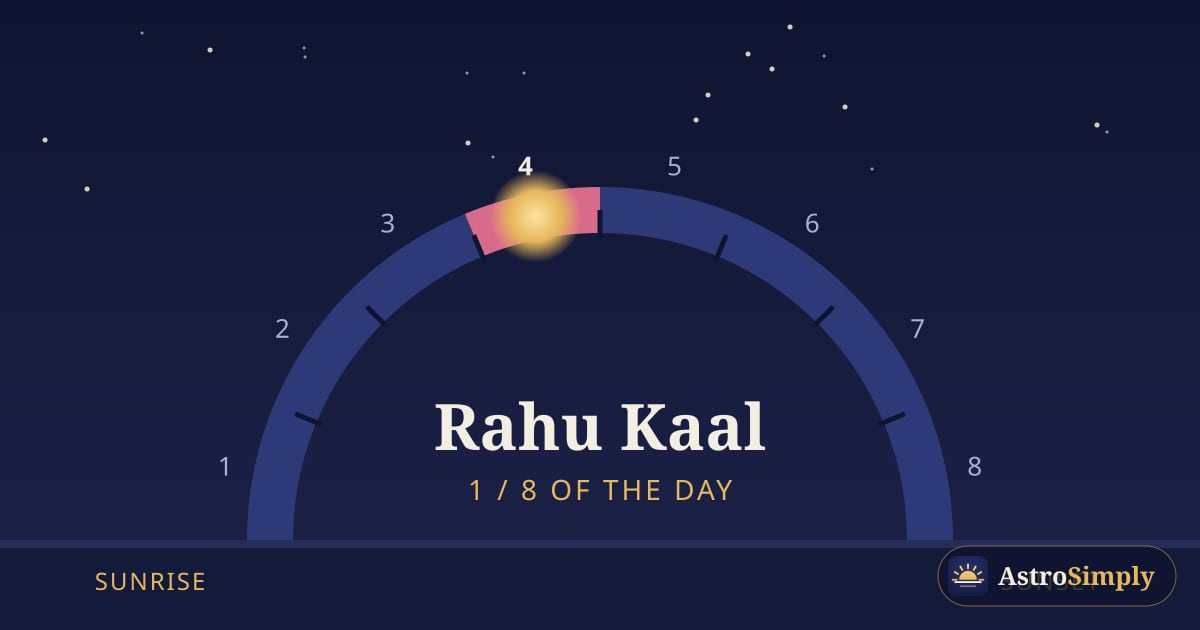
Rahu kaal is one eighth of the daylight, chosen by the weekday. The arithmetic with a real day, the weekday table, where it comes from, what it doesn't stop.