Ravi Pushya on 1 November 2026: the shopping day before Dhanteras
Ravi Pushya yoga falls on Sunday 1 November 2026, five days before Dhanteras. The window, the best Choghadiya, Rahu kaal to skip, and what people buy.
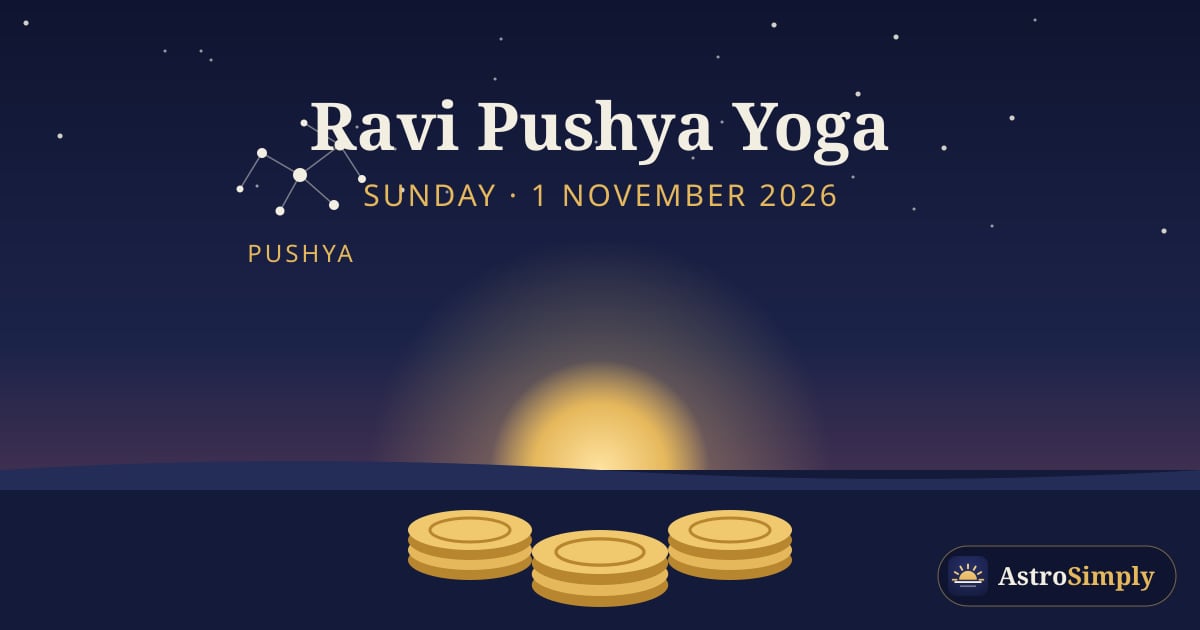
Share these images
Send them to family and friends on WhatsApp, or save them to your phone.
Sunday, 1 November 2026 is a Ravi Pushya day: the Moon is in Pushya nakshatra from before sunrise until 4:30 AM on Monday, and because the day is a Sunday (Ravi-var) the panchang calls the combination Ravi Pushya yoga. Drik Panchang gives the window for Delhi as 6:33 AM on the 1st to 4:30 AM on the 2nd, and lists a Sarvartha Siddhi yoga over the same hours. Dhanteras is five days later, on Friday 6 November.
If you were planning to buy gold or silver, book a vehicle, pick up a phone or make the bigger Diwali purchases, this Sunday is the day the tradition points to, and it has the practical advantage of coming before the Dhanteras crowds. Here is what Pushya is, why jewellers watch for it, the timings for the day, what people actually buy, and a calm word about what a muhurat can and cannot do.
What is Pushya nakshatra?
The Moon passes through the 27 nakshatras in about 27 days, so each one comes round roughly once a month. Pushya is the eighth, lying in the middle of Karka rashi (Cancer), from 3°20’ to 16°40’ of the sign. Its name means “the nourisher”; its symbol is the udder of the cow, and in some lists an arrow or a flower. Its planetary lord is Shani (Saturn) and its presiding deity is Brihaspati, the teacher of the gods, which is an unusual pairing: Saturn’s steadiness with Jupiter’s blessing. The muhurta texts rank Pushya among the most auspicious nakshatras for beginnings of nearly every kind, with one well-known exception, marriage, which most schools do not fix in Pushya.
Drik Panchang describes Pushya as the birth star of Goddess Lakshmi, which is why the Diwali shopping tradition has grown around it: bringing gold home on Pushya is bringing Lakshmi home. It is a belief and a custom, not a promise about the price of gold next year, and that is worth saying plainly.
Why “Ravi” Pushya, and what happened to Guru Pushya?
The weekday adds a flavour. Pushya on a Thursday is Guru Pushya yoga, the most prized, because Thursday is Brihaspati’s own day and he is the deity of the nakshatra. Pushya on a Sunday is Ravi Pushya yoga, the Sun’s day meeting the nourishing star, and the panchangs treat it as nearly as good. In 2026 all three Guru Pushya days (23 April, 21 May and 18 June, by OroPocket’s table) have passed, and the next falls on 18 February 2027, so this Ravi Pushya is the strongest Pushya day of the Diwali season.
A detail that trips people up every year: the Hindu day runs from sunrise to sunrise, so the weekday is the one on which the sun rose. Pushya actually begins at 5:39 AM on Sunday morning in Delhi, nearly an hour before sunrise, and the panchang counts that first hour as part of Saturday; it is too early for any shop anyway. From sunrise at 6:33 AM the whole of Sunday and the small hours of Monday belong to Ravi Pushya.
The timings for Sunday 1 November 2026
A nakshatra changes at the same moment all over India; only sunrise differs. So the window is sunrise on the 1st to 4:30 AM on the 2nd everywhere: 6:33 AM in Delhi, 6:39 AM in Mumbai, a few minutes earlier in Kolkata, a little later in Ahmedabad.
Within that, Drik Panchang marks the better Choghadiya periods for Delhi:
| Period | Delhi time |
|---|---|
| Morning (Chara, Labha, Amrita) | 7:56 AM – 12:04 PM |
| Afternoon (Shubha) | 1:27 – 2:50 PM |
| Evening (Shubha, Amrita, Chara) | 5:36 – 10:28 PM |
The one gap to leave alone is Rahu kaal, which on a Sunday is the last eighth of the day: 4:13 to 5:36 PM in Delhi, and roughly the ninety minutes before sunset in any city. If you want these for your own town, the panchang in the AstroSimply app shows Rahu kaal and the Choghadiya for the day, and the muhurat finder gives dates for a vehicle or a home: app.astrosimply.com/panchang and app.astrosimply.com/muhurat.

What people buy, and what they don’t need to
In jewellers’ shops the Pushya day before Diwali is now busier than Dhanteras for gold; Drik Panchang notes that more gold coins sell on Pushya, while Dhanteras is the day for silver, utensils and the Lakshmi-Ganesh murti. Beyond jewellery, the day is used for the purchases that were going to happen anyway: a two-wheeler or car booking, a phone or laptop, the first entry in a new account book, seeds and plants, and the Diwali clothes.
Two honest notes. A muhurat tells you a good time to begin something you have already decided to do; it is not a reason to buy what you had not planned, and it says nothing about whether the price is right. And the tradition is satisfied by very small things: a silver coin, a gram of gold, a brass diya, even a new broom in some homes. If you are decorating for Diwali, the AstroSimply shop has puja items and home décor delivered across India: astrosimply.com/shop/#home_decor.
A worked example
A family in Jaipur has decided on a two-wheeler for the daughter who has just started college. The showroom opens at ten. They book it on Sunday morning in the Labha-Amrita stretch, around 11 AM, pay the token, and take delivery on a later date fixed with the muhurat finder; the delivery day matters less than the day the decision is sealed. They keep away from the last ninety minutes before sunset, Jaipur’s Rahu kaal, not because anything would go wrong, but because there is no reason to pick the one window the panchang sets aside when the day offers so many others.
Dhanteras itself, for those who prefer it
Dhanteras is Friday 6 November 2026. Drik Panchang’s gold-buying muhurat for Delhi runs from 10:30 AM on the 6th right through to 6:37 AM on the 7th, with a short extra window on Saturday morning until 10:47 AM. There is no need to choose between the two days; many families bring home gold on Pushya and silver or a utensil on Dhanteras, which is the older pattern anyway. Our Diwali post has the Lakshmi Puja muhurat for Sunday 8 November: /blog/diwali-2026-lakshmi-puja-muhurat/. And the same Sunday is Ahoi Ashtami, the mothers’ fast for their children, which ends at the first stars; the nourishing star and the mothers’ vrat fall together this year, a coincidence pandits will enjoy pointing out.
A common misunderstanding
People sometimes read “Pushya is good for everything” and fix a wedding date in it. The muhurta tradition is clear that Pushya is the one great nakshatra left out of marriage muhurtas, even though it is welcomed for the engagement, the griha pravesh and almost everything else. Ask your pandit why if you are curious; the usual answer involves the old story of Brihaspati and the Moon, and it is a reminder that “auspicious” in jyotish is always auspicious for something, never in the abstract.
Frequently asked questions
Is the Ravi Pushya window the same in every city?
The nakshatra is: it ends at 4:30 AM on 2 November everywhere in India. Only the start differs, because the day begins at your local sunrise. Choghadiya and Rahu kaal shift with sunrise and sunset too, so check your own city rather than copying Delhi’s table.
Can I buy online, or does the muhurat need a shop?
The tradition is about the moment you commit, so an online order placed within the window is what most families go by; the delivery date is the courier’s business, not the panchang’s. If you want the item in hand on the day, buy it in the morning.
Is Pushya good for griha pravesh, a new business and travel too?
Yes. For griha pravesh, opening a business, a journey, planting, starting studies and buying land or a vehicle, Pushya is among the best nakshatras in the muhurta texts. Marriage is the exception, so wedding dates are not fixed in Pushya even though almost everything else is.
Sources
Read next

Diwali 2026 Lakshmi Puja muhurat: why Pradosh kaal and a fixed lagna
Diwali 2026 is on Sunday 8 November. The Lakshmi Puja window, city by city, how the muhurat is worked out from Amavasya tithi, Pradosh kaal and a fixed lagna.
Karwa Chauth 2026: moonrise time city by city and the puja muhurat
Karwa Chauth 2026 is on Thursday 29 October. Moonrise and puja timings for ten cities, why the moon rises late, the day's panchang, and wishes to share.
Jupiter enters Simha on 31 October 2026: what it means for your rashi
Jupiter leaves Karka for Simha on 31 October 2026 and stays till 25 January 2027. How to count the transit from your Moon sign and read it sensibly.