Muhurat: why timing matters, and what makes a time good or bad
What a muhurat really is, the five layers that make a time good, what Rahu Kaal and Kaal choghadiya mean, and a real example: buying a car in Delhi.

Share these images
Send them to family and friends on WhatsApp, or save them to your phone.
A muhurat is a time chosen so that it suits the work you’re about to begin. Hindu tradition holds that time isn’t neutral: each stretch of the day has a quality, set by the Moon’s phase, the nakshatra, the weekday and the slice of the day you’re in, and a good muhurat is simply a moment where those qualities line up with what you want to start. A “bad” time doesn’t bring harm. It’s a time tradition would rather you didn’t use to begin something new.
The longer answer has a clear logic, and once you see it you can read a panchang yourself. We’ll finish with a real day, worked step by step.
Muhurat began as a 48-minute unit of time
Before it meant “an auspicious time”, muhurat (मुहूर्त, muhūrta) was a measurement. In the Rigveda the word simply means “a moment”; in the Brahmanas, the prose texts on Vedic ritual, it is a precise unit, one thirtieth of a day and night. Thirty muhurats in 24 hours makes each one 48 minutes, and the Taittiriya Brahmana already gives the thirty their names.
Fifteen belong to the day and fifteen to the night, each with its own name and character. Two are still famous. The eighth of the day, the one that sits across local noon, is Abhijit, “the victorious”. And the second-last muhurat of the night is Brahma muhurta, the quiet hour before dawn that students and early risers still prize.
One detail most people miss: 48 minutes is only the average. A day muhurat is a fifteenth of the actual time between sunrise and sunset, so it shrinks in winter and stretches in summer. In Delhi on 18 November 2026, daylight lasts about 10 hours 41 minutes, so each day muhurat is about 43 minutes, and each night one about 53.
As choosing times grew into its own branch of jyotish (muhurta shastra, with manuals such as the 16th-century Muhurta Chintamani), the unit’s name came to stand for the whole practice. When a family says “muhurat nikalwana hai” today, they mean: find us the right moment.
Kaal: the idea that time has a quality
In Sanskrit, kaal (काल) means time, and often destiny too, the force that moves all things along. That double meaning tells you how Indian thought looks at the clock: time isn’t an empty container. It has a texture.
Every farmer already knows this. The same seed, in the same field, from the same hand, grows well when sown in its season and struggles when sown out of it. Nothing about the seed changed. The time did. Muhurta applies that farmer’s sense to human beginnings: a wedding, a griha pravesh, a shop’s first account entry, the day a new car comes home. That’s the whole philosophy, and notice what it doesn’t say. It doesn’t say a poorly timed start is doomed. It says a well-timed one is helped.
The five layers used to judge a time
When I look for a muhurat, I read five layers, from the slowest-changing to the most personal.
| Layer | What it is | What tradition looks for |
|---|---|---|
| 1. Tithi and paksha | The lunar day, and whether the Moon is waxing (Shukla) or waning (Krishna) | A growing Moon for new beginnings; some tithis preferred, a few passed over |
| 2. Nakshatra | Which of the 27 lunar mansions the Moon is in | A nakshatra whose nature matches the work |
| 3. Vara (weekday) | The planet that rules the day | A day whose planet suits the purpose |
| 4. The day’s slices | Choghadiya, Rahu Kaal, Abhijit muhurat, and related periods | A good slice, outside the windows set aside for avoiding new starts |
| 5. Your own chart | Your birth Moon and nakshatra, and for big events the rising sign | A time that’s kind to you, not just to the day |
Tithi: the Moon’s phase
The tithi is the lunar day, the time it takes the Moon to gain 12 degrees on the Sun. Tradition generally prefers the bright half, Shukla paksha, when the Moon grows towards full, for beginnings. The tithis also fall into five groups, and the fourth, ninth and fourteenth (Chaturthi, Navami and Chaturdashi) are called rikta, “empty”. Muhurat manuals usually pass them over for big celebrations and welcome the purna, “full”, tithis (the fifth, tenth and fifteenth). This comes up in our example.
Nakshatra: where the Moon is
This layer does the most matching. The classical muhurat texts sort the 27 nakshatras by nature:
| Nature | Nakshatras | Traditionally suited to |
|---|---|---|
| Sthira (fixed) | Rohini, Uttara Phalguni, Uttara Ashadha, Uttara Bhadrapada | Things meant to last: foundations, griha pravesh, planting |
| Chara (movable) | Punarvasu, Swati, Shravana, Dhanishtha, Shatabhisha | Movement: travel, vehicles, starting a journey |
| Kshipra (swift) | Ashwini, Pushya, Hasta | Quick work: trade, learning, opening a shop |
| Mridu (soft) | Mrigashira, Chitra, Anuradha, Revati | Gentle things: friendship, arts, new clothes, celebrations |
| Mishra (mixed) | Krittika, Vishakha | Everyday and routine work |
| Ugra (bold) and Tikshna (sharp) | Bharani, Magha, the three Purvas; Ardra, Ashlesha, Jyeshtha, Mula | Firm, decisive tasks; usually passed over for celebrations |
So a house warming looks for a fixed nakshatra, a car for a movable one: you want the house to stay and the car to go. (Pushya, the best known of the swift group, has its own post: Ravi Pushya and the shopping day before Dhanteras.)
Vara: the weekday
Each weekday belongs to a planet, Sunday to the Sun through to Saturday to Saturn. Wednesday, Mercury’s day, is linked with trade and transactions, a natural day for a purchase; Thursday (Jupiter) is favoured for learning, Friday (Venus) for comfort and celebration.
The day’s slices: choghadiya, Rahu Kaal and Abhijit
This layer changes hour by hour. From sunrise to sunset the day is cut into eight choghadiyas (the name means “four ghadis”; a ghadi is 24 minutes, so a choghadiya is roughly 96 minutes, longer in summer and shorter in winter). The night gets eight more.
| Choghadiya | Planet | Meaning of the name | Traditional use |
|---|---|---|---|
| Amrit | Moon | nectar | The best: good for almost any beginning |
| Shubh | Jupiter | auspicious | Ceremonies, weddings, religious work, learning |
| Labh | Mercury | gain | Business, buying, study, new ventures |
| Chal | Venus | moving | Travel and vehicles; acceptable for routine work |
| Udveg | Sun | restlessness | Not ideal for new starts |
| Rog | Mars | ailment | Not ideal for new starts |
| Kaal | Saturn | time | Not ideal for new starts |
The last three names sound alarming, and they shouldn’t. They describe the tradition’s view of that slice for beginning something, not a forecast for anyone living through it.
There’s a quiet pattern in the order. The day opens with the weekday planet’s own choghadiya (Labh, Mercury’s, on a Wednesday), and the rest follow a fixed cycle: Sun, Venus, Mercury, Moon, Saturn, Jupiter, Mars. So every Wednesday has the same sequence; only the clock times move.
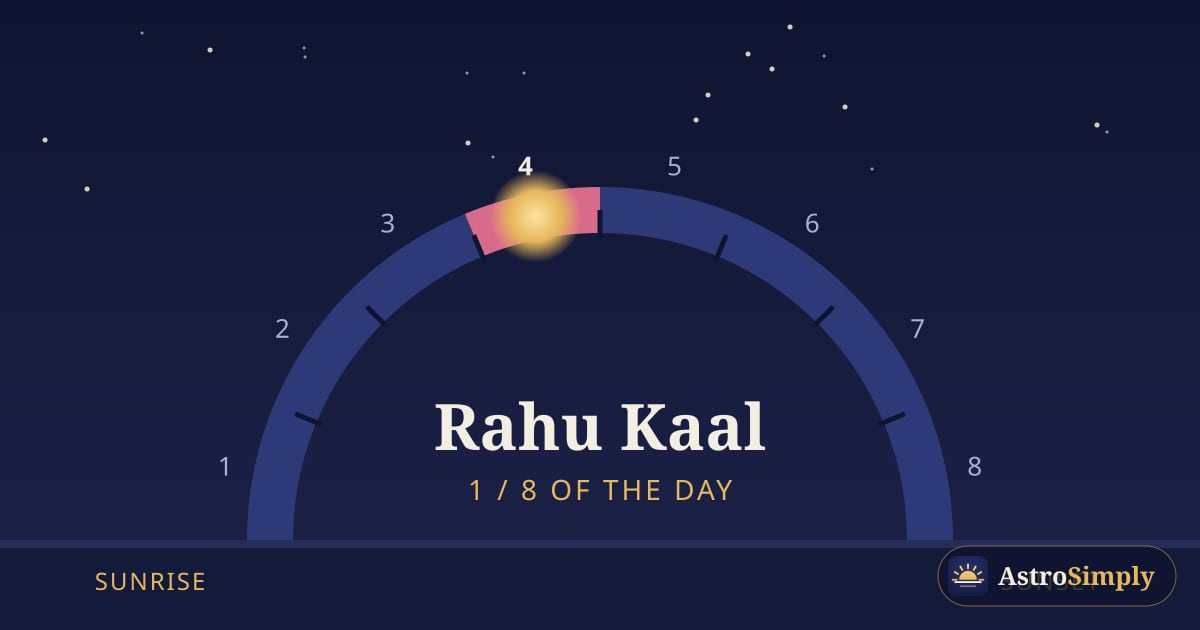
Rahu Kaal is one eighth of the daylight, a different eighth for each weekday; our full guide: Rahu kaal: how it is calculated for your city. South Indian practice also marks Yamaganda and Gulika kaal, two more eighths.
The Abhijit muhurat is the eighth daytime muhurat, the one centred on local noon. Tradition counts it good for almost any work, the fallback when nothing else lines up, with one surprising exception: on Wednesdays it’s traditionally not used, and our panchang marks it so. Here’s something you can check yourself: Wednesday’s Rahu Kaal is the fifth eighth of the day, which always begins at exactly the midpoint of daylight, that is, at local noon. So on a Wednesday the second half of Abhijit would fall inside Rahu Kaal anyway. It’s an easy way to remember the rule.
Your own chart
The fifth layer asks whether the day is good for you. An astrologer looks at tara bala (how the day’s nakshatra stands counted from your birth nakshatra) and chandra bala (where the transiting Moon falls from your birth rashi), and for the biggest occasions, such as a wedding or griha pravesh, the rising sign at the chosen minute as well. That’s why two brothers can be given different hours on the same day. Our Diwali post shows the rising-sign layer at work: why Lakshmi puja is placed in a fixed lagna.
What “bad” time really means
This is where most of the worry comes from, so let me be plain. Rahu Kaal, a Kaal or Rog choghadiya, Yamaganda: none of these means something bad will happen to you. The rule tradition attaches to them is narrow. Don’t begin something new and important in this window, if you can choose.
Everything else carries on. A journey already under way doesn’t stop when Rahu Kaal starts, and work begun earlier isn’t spoiled by continuing through it. A meeting someone else fixed, a flight time printed on a ticket, a child’s arrival: you didn’t choose these, so there’s nothing to judge. If an offer letter arrives in Rahu Kaal, accept it.
Think of a “bad” slice as a pause, not a warning: 80 minutes to finish preparing, gather the family and start at the next good slice.
A real example: buying a car in Delhi on Wednesday 18 November 2026
Suppose a family in Delhi plans to bring home a new car on Wednesday 18 November 2026. Here’s how the layers read. All times are AstroSimply’s own calculation for New Delhi, in IST.
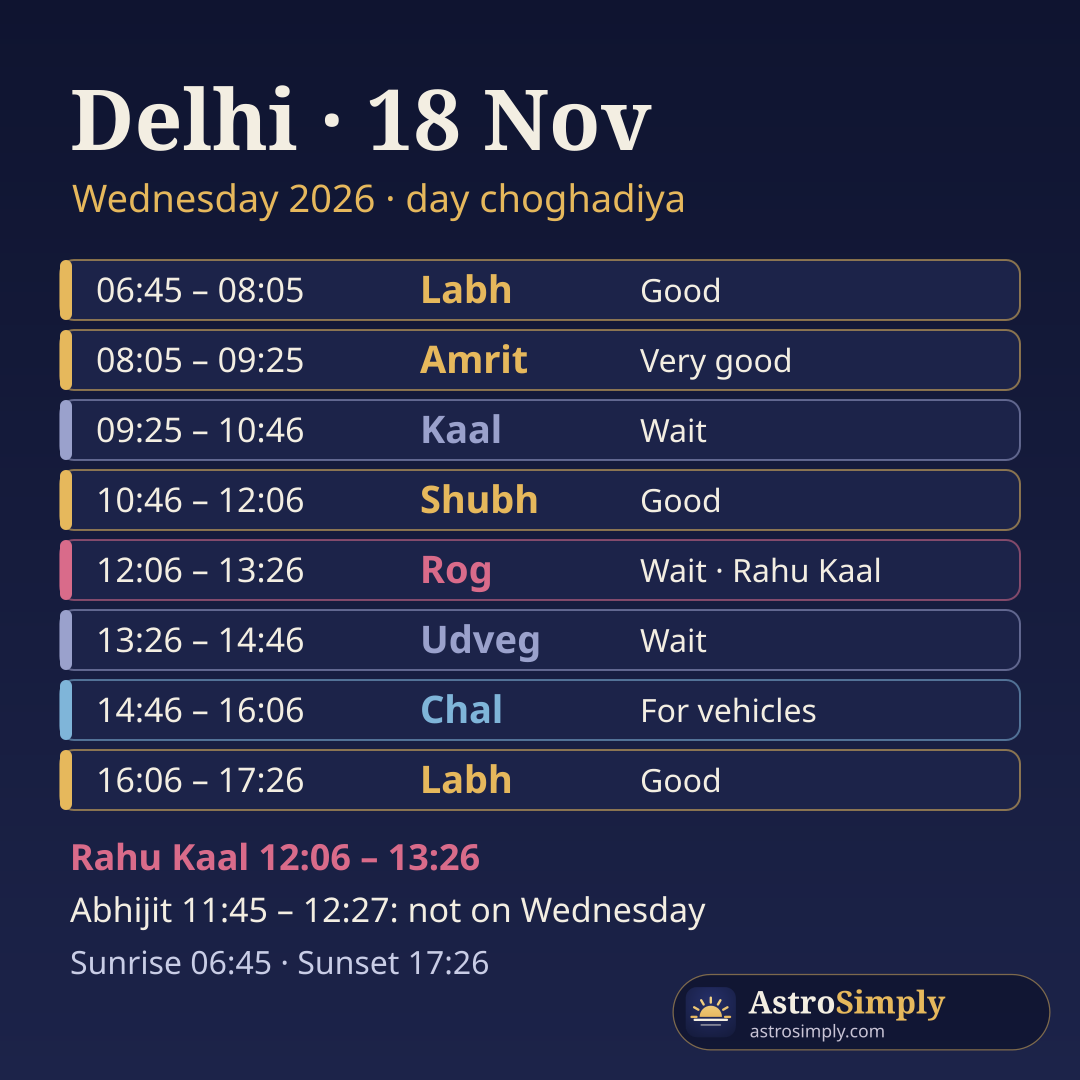
Layers 1 to 3. The month is Kartika and it’s Shukla paksha, the waxing half: a good sign for a beginning. The Moon is in Shatabhisha all day, until 06:10 the next morning, and Shatabhisha is one of the five chara, movable, nakshatras, the group tradition favours for vehicles and travel. It’s Wednesday, Mercury’s day of transactions. So far, so good.
There’s one wrinkle an honest reading has to mention. The tithi is Shukla Navami, and Navami is one of the rikta tithis that muhurat manuals usually pass over for big beginnings. Yet this particular Navami is also Akshaya (Amla) Navami, which many families in north and east India treat as one of the brightest days of Kartika for charity and good deeds. When layers pull in different directions, an astrologer weighs them, and family custom often decides. Many families would happily buy on this day; a strict follower of the texts might pick another.
Layer 4: the slices. Sunrise is at 06:45 and sunset at 17:26.
| Time | Choghadiya | Reading for a car purchase |
|---|---|---|
| 06:45 – 08:05 | Labh | Good |
| 08:05 – 09:25 | Amrit | Very good |
| 09:25 – 10:46 | Kaal | Wait |
| 10:46 – 12:06 | Shubh | Good |
| 12:06 – 13:26 | Rog (also Rahu Kaal) | Wait |
| 13:26 – 14:46 | Udveg | Wait |
| 14:46 – 16:06 | Chal | Fitting for vehicles |
| 16:06 – 17:26 | Labh | Good |
Rahu Kaal runs from 12:06 to 13:26, the fifth eighth of the day, as every Wednesday. The Abhijit muhurat would be 11:45 to 12:27, but it’s Wednesday, so it’s set aside, and you can see its second half runs straight into Rahu Kaal.
For most North Indian families the choice would be Amrit, 08:05 to 09:25, or Shubh, 10:46 to 12:06, with Chal, 14:46 to 16:06, as a fitting afternoon option for a vehicle.
A closer look. A fuller panchang adds Yamaganda, 08:05 to 09:25 (the same window as Amrit), and Gulika kaal, 10:46 to 12:06 (the same as Shubh). South Indian practice skips Yamaganda for new starts; Gulika is read differently, since what begins in it is said to repeat, which many find fine for buying things. The yoga of the day, another panchang element, is Dhruva (“steady”) until 08:05 and Vyaghata after that, and Vyaghata is one of the yogas muhurat texts list as less favourable. Put those together and one slot clears every check: the Labh choghadiya at sunrise, 06:45 to 08:05. It sits outside Rahu Kaal, Yamaganda and Gulika, and inside Dhruva yoga.
No showroom opens at seven, and tradition is practical: many families do the small puja or pay the booking amount in their chosen window and drive the car home later. The muhurat marks the beginning, not the whole errand.
Layer 5, the buyer’s own chart, is the part no general article can do for you.
Why it still matters today
Some people call all this superstition. But watch a family choosing a muhurat and you’ll see something else.
It slows a big decision down: everyone stops and asks, are we ready?
It brings the family together. Grandparents, parents and children agree on one moment, and a purchase becomes a small occasion with a diya and a sweet.
It’s a beginning made with intention. Whatever you believe about planets, starting calm and prepared at a time you chose is a good habit.
And it keeps a living tradition alive: thirty muhurats named in texts thousands of years old still guide millions of families. You don’t have to follow it. It’s worth understanding.
How to find a good time yourself
- Pick the day. Shukla paksha, a nakshatra that matches the work, a suitable weekday: the panchang shows them for any date.
- Pick the slice. The free choghadiya tool shows Amrit, Shubh and Labh (and Chal, for vehicles) for your city.
- Step around Rahu Kaal with the Rahu Kaal tool; if it overlaps your slice, take the next good one.
- Use Abhijit as a fallback, except on Wednesdays.
- For a big occasion, add your chart. Our app’s muhurat finder weighs dates for marriage, griha pravesh or a vehicle against your city and chart: app.astrosimply.com/muhurat.
For the longer rhythms of your life, the periods that shape years rather than hours, our 35-page kundali report covers your dashas and the next ten years in plain words, as a PDF checked by our astrologer before it’s sent.
Watch: muhurat explained (6-minute video)
Prefer to watch? This animated video shows why tradition says time has a quality, what a muhurat really is, the five layers of a good time, the day in slices (choghadiya, Rahu Kaal, Abhijit), what “bad” time really means, and the Delhi example above, step by step.
▶ Watch on YouTube: https://youtube.com/watch?v=JbZuAwsRyr8
- 0:00 Why the exact minute matters
- 0:38 The whole idea on one page
- 1:13 Time has a quality
- 1:45 What a muhurat really is
- 2:16 Five layers of a good time
- 2:57 The day in slices
- 3:34 What ‘bad’ time really means
- 4:09 A real example, step by step
- 5:02 Why it still matters
- 5:23 So, is time good or bad?
- 5:43 Recap
- 5:55 Find your own good time
- 6:18 Like, share, subscribe
Frequently asked questions
What is a shubh muhurat?
A time judged good for starting a particular piece of work: a waxing Moon where possible, a suitable nakshatra and weekday, a good choghadiya, outside Rahu Kaal. It’s always “good for something”: a time ideal for travel may not suit a griha pravesh.
How long is a muhurat?
As a unit, a thirtieth of a day and night: 48 minutes on average, shorter by day in winter and longer in summer. In everyday speech “muhurat” just means the chosen auspicious time, whatever its length.
Is Rahu Kaal bad? Can I do daily work in it?
Rahu Kaal is set aside only for not starting new, important work. It isn’t harmful, and routine life carries on: meals, office work, planned travel and work already begun. Step around it only when you’re free to choose the start of something big.
What is Abhijit muhurat, and why not on Wednesday?
The eighth of the fifteen daytime muhurats, centred on local noon, good for almost any beginning. By custom it isn’t used on Wednesdays, when Rahu Kaal also begins at noon, so most panchangs mark it unavailable that day.
What’s the difference between choghadiya and muhurat?
A muhurat, in the old sense, is one of thirty divisions of the day and night (about 48 minutes); a choghadiya is one eighth of the day or night (about an hour and a half). The choghadiya is the quick everyday check, especially in Gujarat, Rajasthan and the north; a full muhurat for a big event weighs all five layers.
Sources
Read next
Rahu kaal: how it is calculated for your city, and what it is for
Rahu kaal is one eighth of the daylight, chosen by the weekday. The arithmetic with a real day, the weekday table, where it comes from, what it doesn't stop.

Diwali 2026 Lakshmi Puja muhurat: why Pradosh kaal and a fixed lagna
Diwali 2026 is on Sunday 8 November. The Lakshmi Puja window, city by city, how the muhurat is worked out from Amavasya tithi, Pradosh kaal and a fixed lagna.

Ravi Pushya on 1 November 2026: the shopping day before Dhanteras
Ravi Pushya yoga falls on Sunday 1 November 2026, five days before Dhanteras. The window, the best Choghadiya, Rahu kaal to skip, and what people buy.