Rashtriya Ekta Diwas 2026: Sardar Patel's 151st birth anniversary
National Unity Day is Saturday 31 October 2026, Sardar Vallabhbhai Patel's 151st birth anniversary. His story in plain words, how the day is kept, and wishes.
Share these images
Send them to family and friends on WhatsApp, or save them to your phone.
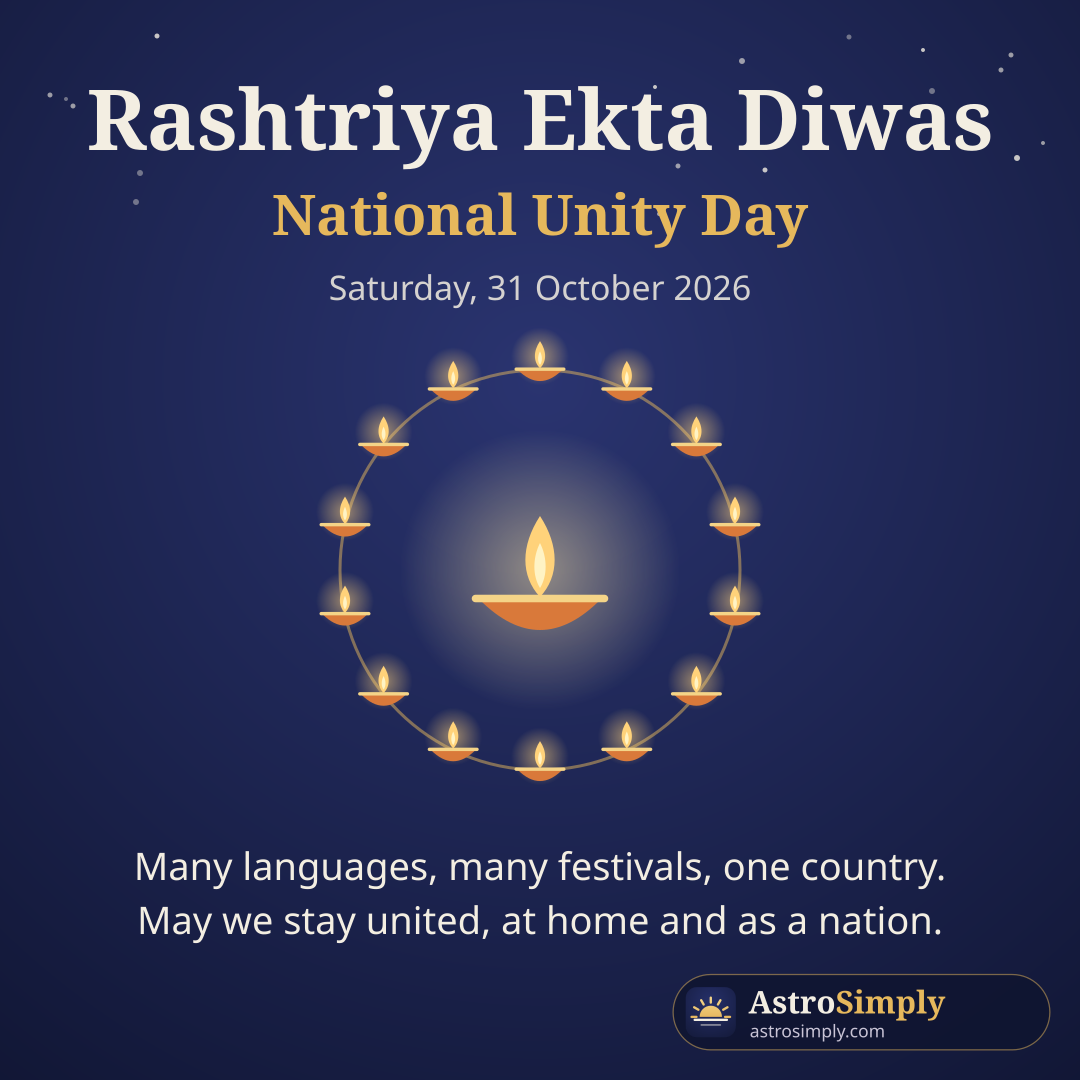
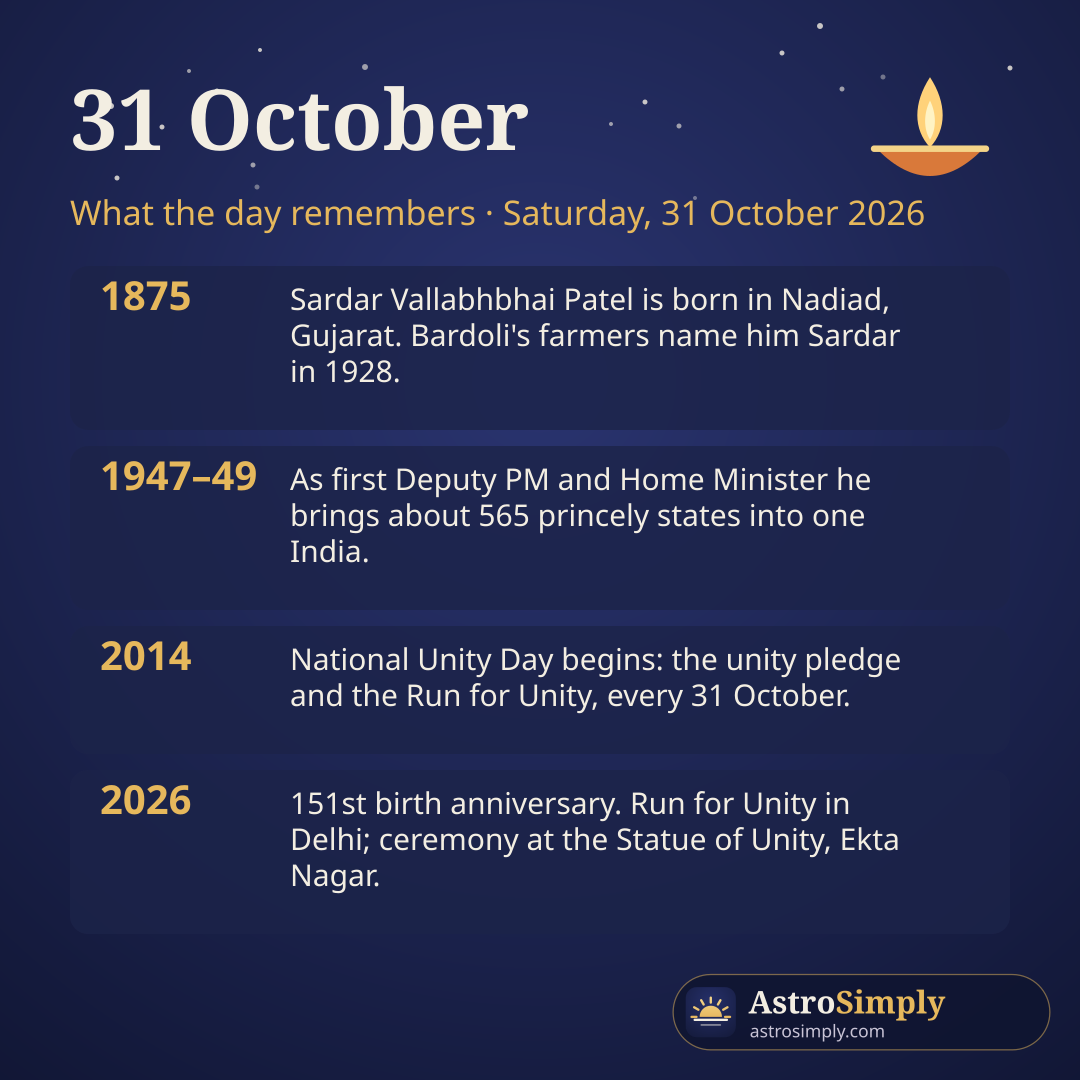
Saturday, 31 October 2026 is Rashtriya Ekta Diwas, National Unity Day, kept every year on the birth anniversary of Sardar Vallabhbhai Patel. He was born on 31 October 1875, so this year’s is the 151st, and it closes the two-year commemoration of his 150th that began in 2024. Across the country the morning brings the unity pledge in schools and offices and the Run for Unity; in Delhi the Home Ministry has fixed the run at the Major Dhyan Chand National Stadium, and the main programme is again at Ekta Nagar in Gujarat, at the foot of the Statue of Unity.
This post is for families who want to mark the day well: who Sardar Patel was, told simply enough for a child, why unity is the word attached to his name, how the day is observed, and a few messages you can send in the morning. The greeting cards below are made for WhatsApp.
Who was Sardar Patel?
Vallabhbhai Jhaverbhai Patel was born in Nadiad in Gujarat into a farming family from Karamsad. He qualified as a pleader, and only at thirty-six went to London to read for the bar at the Middle Temple, where he finished the thirty-six-month course in thirty months and topped his class. Back in Ahmedabad he built a successful practice, and might have stayed a barrister had Kheda not happened.
In 1918 the farmers of Kheda district, hit by crop failure, could not pay the land tax, and the government would not relent. Gandhi ji asked for a Gujarati who would organise the villages; Patel put down his practice and did it, walking from village to village, documenting grievances and leading a disciplined refusal to pay until the tax was suspended. Ten years later, in 1928, he did the same at Bardoli against a steep tax increase. The settlement there repealed the increase and returned the seized land, and it was the women of Bardoli who first called him Sardar, the chief. The name stayed.
He served Ahmedabad as municipal president three times in the 1920s, bringing electricity, drainage and better schools, and organised relief in the floods of 1927. He was jailed repeatedly in the freedom movement and spent most of the war years in prison with the rest of the Congress Working Committee.
Why “unity” is the word attached to him
When India became independent on 15 August 1947, Patel became the first Deputy Prime Minister and Home Minister. The country he took charge of was not yet one country: alongside the provinces of British India there were about 565 princely states, each with its own ruler, each legally free to join India, join Pakistan or stand alone. The map of India as we draw it did not exist.
In a little over two years Patel and his colleague V. P. Menon persuaded nearly all of those states to accede, by patient negotiation, by the offer of privy purses and honours, and where necessary by firmness. Junagadh, Hyderabad and Jammu and Kashmir each took a different and more difficult path, and the histories of those three are long stories in themselves. But the quiet achievement, the one children should hear, is that hundreds of separate states became one administrative and political India without a general war among them. That is why he is often called the Iron Man of India, and why the word unity belongs to his day.
He also insisted on a single, politically neutral civil service for the whole country. The Indian Administrative Service and the Indian Police Service, the “steel frame” that runs district offices from Kutch to Kohima, are his design, and 21 April, the day he addressed the first batch of officers in 1947, is now Civil Services Day.
Sardar Patel died in Bombay on 15 December 1950, aged seventy-five. He was awarded the Bharat Ratna in 1991. The Statue of Unity, 182 metres tall and the tallest statue in the world, was unveiled on his birthday in 2018 on Sadhu Bet, a river island in the Narmada facing the Sardar Sarovar dam in Narmada district, Gujarat; the place is now called Ekta Nagar. The sculptor was Ram V. Sutar.
How Rashtriya Ekta Diwas is observed
The Government of India introduced the day in 2014. Three things happen on it almost everywhere.
The unity pledge. In government offices, schools and colleges people stand together and read a short pledge to preserve the unity, integrity and security of the nation and to spread that message among fellow citizens. It takes a minute. Many families now say it at home with their children.
The Run for Unity. A short morning run or walk, usually two to five kilometres, held in cities and towns across the country. In 2026 the Delhi run is at the Major Dhyan Chand National Stadium on the morning of 31 October, with central government staff invited to take part voluntarily; most state capitals and many districts hold their own. Nobody times you. You turn up in sports shoes, run or walk with neighbours, and go home for breakfast.
Ekta Nagar. At the Statue of Unity there is a formal ceremony with floral tributes, and in recent years a parade with contingents from the police and central forces. The complex is open to visitors, and the last week of October is a good time to go; book the viewing gallery in advance.
Doing the day at home
For a family that is not going anywhere, three small things make the day real for children. Tell the story of the 565 states with a map in front of you; ask which state your own town belonged to in 1947, which is a surprisingly good conversation. Say the pledge together. And cook something from a region of India that is not your own for dinner; unity is pleasanter to understand with food on the table.
Schools often ask for a short essay or speech. The honest outline is: born 1875, Nadiad; lawyer; Kheda and Bardoli; the Sardar title; Deputy Prime Minister and Home Minister; the integration of the states; the civil services; died 1950; Bharat Ratna 1991; Statue of Unity 2018. Children who can say those ten lines in order know more than most adults.
Messages you can send on 31 October
- Happy Rashtriya Ekta Diwas. Many languages, many festivals, one country. Grateful for the people who made it one.
- On Sardar Patel’s 151st birth anniversary, a small wish for a big idea: may we stay united, at home and as a nation.
- Unity is a daily habit, not a slogan. Happy National Unity Day to you and your family.
- Remembering the Sardar today. Strength with gentleness, firmness with patience; may we learn a little of both.
- Ekta Diwas ki shubhkamnayein. Run a little, read the pledge, and call someone from another part of India.
Frequently asked questions
Is 31 October 2026 a public holiday?
No. Rashtriya Ekta Diwas is an observance, not a gazetted holiday; schools and offices are open, which is exactly where the pledge and the run take place. Some states hold their main events early in the morning so that people can carry on with the working day.
What is the difference between National Unity Day and Civil Services Day?
Both honour Sardar Patel. National Unity Day, 31 October, is his birth anniversary and remembers the integration of the princely states. Civil Services Day, 21 April, remembers his address to the first batch of Indian Administrative Service officers in 1947, in which he called the services the steel frame of the country.
How tall is the Statue of Unity, and where exactly is it?
The statue itself is 182 metres, the tallest in the world, and it stands on Sadhu Bet island in the Narmada river facing the Sardar Sarovar dam, in Narmada district, Gujarat, about 100 kilometres southeast of Vadodara. The place is called Ekta Nagar, formerly Kevadia. It was unveiled on 31 October 2018.
Sources
Read next
Ahoi Ashtami 2026: star sighting time city by city and the puja
Ahoi Ashtami 2026 is on Sunday 1 November. Star-sighting and puja timings for ten cities, the Ahoi Mata story, how the day goes, and wishes to send.
Ravi Pushya on 1 November 2026: the shopping day before Dhanteras
Ravi Pushya yoga falls on Sunday 1 November 2026, five days before Dhanteras. The window, the best Choghadiya, Rahu kaal to skip, and what people buy.
Baby name by nakshatra: the 108 pada syllables and how to use them
How Namakaran picks a baby's first syllable from the Moon's nakshatra and pada. The full table of 108 letters, a worked example, regional customs, odd sounds.