Ahoi Ashtami 2026: star sighting time city by city and the puja
Ahoi Ashtami 2026 is on Sunday 1 November. Star-sighting and puja timings for ten cities, the Ahoi Mata story, how the day goes, and wishes to send.
Share these images
Send them to family and friends on WhatsApp, or save them to your phone.
Ahoi Ashtami 2026 falls on Sunday, 1 November. In Delhi the evening puja window runs from 5:36 PM to 6:54 PM, and the first stars are expected at about 6:00 PM, which is when most mothers end the fast. Drik Panchang and the Sunday Guardian both give this date and these Delhi timings; a handful of websites list 2 November, and the section on the tithi below explains why the 1st is right.
This is the quieter cousin of Karwa Chauth, kept four days later and a week before Diwali, and it is a fast for one’s children rather than for a husband. Below: the star-sighting time for ten cities, the panchang of the day, the story of Ahoi Mata as it is told in most homes, how the evening goes, and a few wishes you can send on Sunday morning.
When can you see the stars in your city?
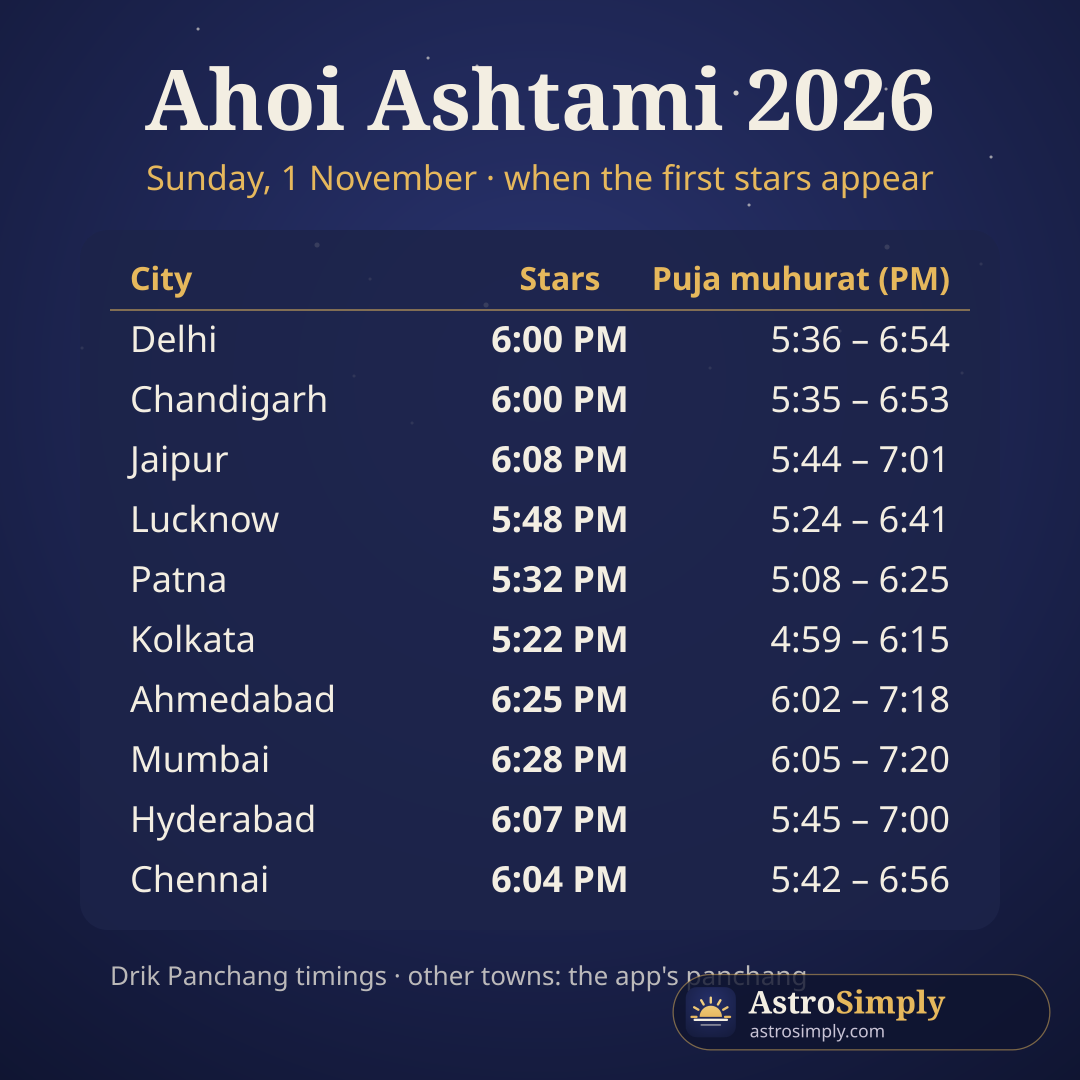
These are Drik Panchang’s figures for 1 November 2026. The puja muhurat is the twilight window after sunset for the katha and the offering; “stars” is the time the first stars become visible (sanjh), when the fast is usually broken. Moonrise is listed because a few families wait for the moon, but notice how late it is.
| City | Puja muhurat | Stars | Moonrise |
|---|---|---|---|
| Delhi | 5:36 – 6:54 PM | 6:00 PM | 11:40 PM |
| Chandigarh | 5:35 – 6:53 PM | 6:00 PM | 11:38 PM |
| Jaipur | 5:44 – 7:01 PM | 6:08 PM | 11:50 PM |
| Lucknow | 5:24 – 6:41 PM | 5:48 PM | 11:28 PM |
| Patna | 5:08 – 6:25 PM | 5:32 PM | 11:13 PM |
| Kolkata | 4:59 – 6:15 PM | 5:22 PM | 11:05 PM |
| Ahmedabad | 6:02 – 7:18 PM | 6:25 PM | 12:10 AM |
| Mumbai | 6:05 – 7:20 PM | 6:28 PM | 12:15 AM |
| Hyderabad | 5:45 – 7:00 PM | 6:07 PM | 11:55 PM |
| Chennai | 5:42 – 6:56 PM | 6:04 PM | 11:54 PM |
The pattern is the one we saw on Karwa Chauth: the east finishes first. Kolkata’s stars are out forty minutes before Delhi’s and more than an hour before Mumbai’s, simply because the sun sets earlier there. In every city the star time is about twenty-five minutes after sunset, so if your town is not listed, take your local sunset and add twenty-five minutes; on a clear evening the first stars will be out by then. The panchang in the AstroSimply app gives sunset for any town: app.astrosimply.com/panchang.
Why 1 November and not the 2nd
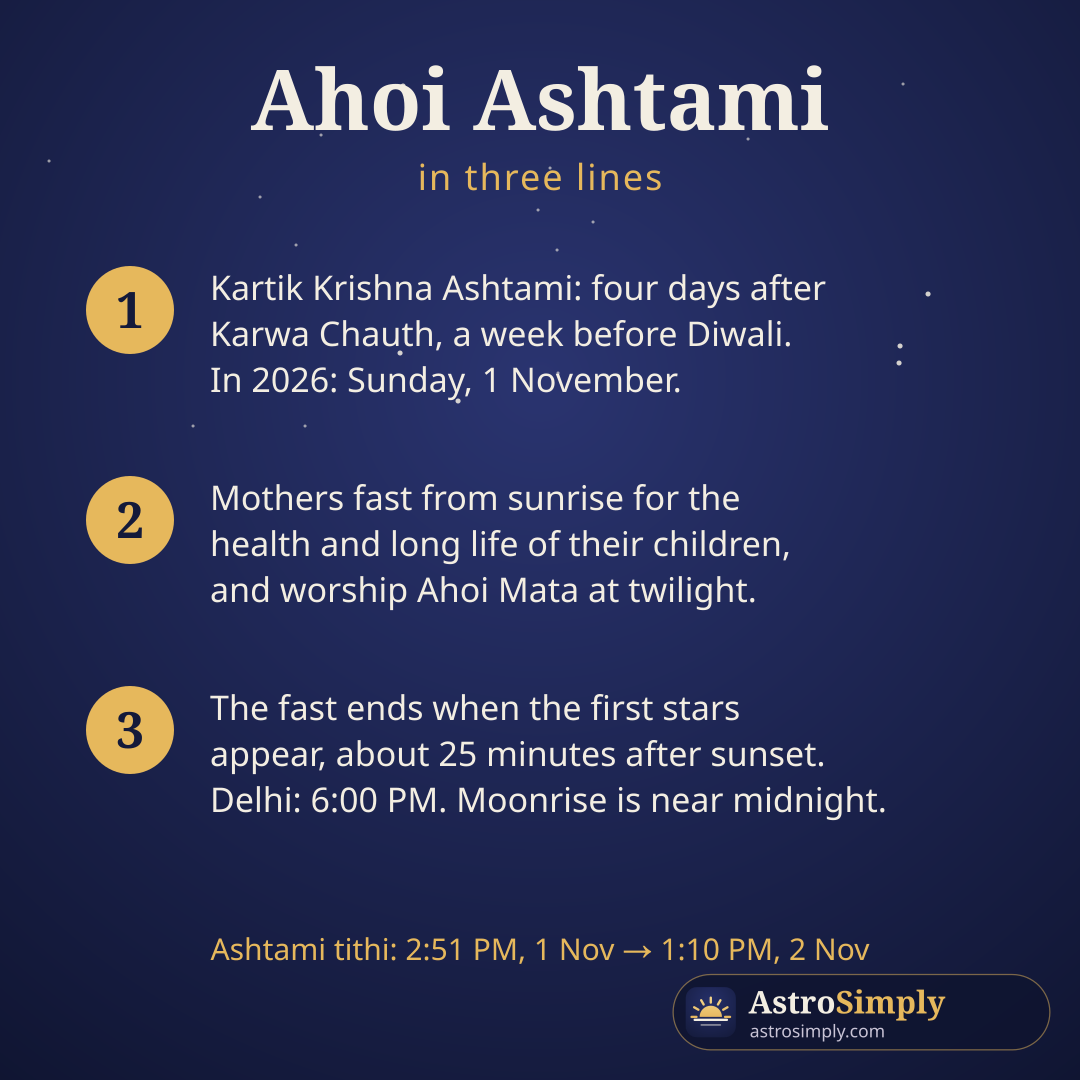
Ahoi Ashtami is kept on the Ashtami, the eighth tithi, of the dark fortnight of Kartik (Ashwin in the Amanta calendar of Gujarat, Maharashtra and the south; the day itself is the same everywhere). This year the Ashtami tithi begins at 2:51 PM on 1 November and ends at 1:10 PM on 2 November.
The rule for this vrat is that the Ashtami should be present at twilight, because the puja and the star sighting happen then. On the 1st, Ashtami has begun by the afternoon and covers the whole evening. On the 2nd it is over by lunchtime, so an evening puja on the 2nd would fall in Navami. That is why Drik Panchang, PanchangBodh, AstroTalk and the newspapers all put the fast on Sunday the 1st. The sites that say the 2nd are reading the date on which the tithi ends, a common slip in the Kartik fortnight.
The panchang of the day
For Delhi, Drik Panchang lists sunrise at 6:33 AM and sunset at 5:36 PM, so the fast runs about eleven and a half hours, shorter than Karwa Chauth’s fourteen because the moon is not involved. Until 2:51 PM the tithi is Saptami, then Ashtami. The nakshatra all day is Pushya, which gives Sunday 1 November a second distinction: Pushya on a Sunday is Ravi Pushya yoga, and the panchang also marks a Sarvartha Siddhi yoga from sunrise to 4:30 AM the next morning. Pushya means “the nourisher”, the nakshatra the muhurta tradition likes best for almost any beginning, and a lovely star to keep a mother’s fast under.
Rahu kaal in Delhi is 4:13 PM to 5:36 PM, which ends exactly at sunset and does not touch the puja window.
Who Ahoi Mata is, and the story families tell
Ahoi Mata is the mother goddess of this vrat, worshipped as a protector of children; she is a form of the Devi, and families identify her with Parvati or with Lakshmi. Her image is drawn on a wall with geru (red ochre) or kept on a printed cloth: an eight-cornered figure, with little children around her and, beside her, a syahu, the animal of the story. In Punjab and Haryana the syahu is a porcupine; in other tellings it is a lioness.
The katha, told in many variations, goes like this. A merchant’s wife went to the forest to dig earth for the repair of her house before Diwali. Her spade struck the den of a syahu and one of its cubs died. The grief of the mother animal became a curse on her, and over the years she lost her own children one after another. Broken, she and her husband set out to end their days, and on the way a voice told them to turn back, to serve a cow, and to draw the syahu and her cubs and worship Ahoi Mata on the Ashtami of Kartik with a true heart. She did, year after year, and her children were restored to her.
Told plainly, it is a story about carelessness, remorse and repair, and about a mother’s prayer being heard. That is why in many homes the women also ask forgiveness in the puja for any harm they may have caused without knowing.
How the day goes
The fast is kept mainly in Punjab, Haryana, Delhi, Uttar Pradesh, Rajasthan, Madhya Pradesh, Himachal and Jammu, and by families from those regions wherever they now live. Traditionally it was for sons; today almost every mother keeps it for all her children.
Morning. A bath, then the sankalp, the spoken intention to keep the fast for the children’s well-being. The vrat is traditionally nirjala, without water, but it has never been a test of endurance; anyone who is unwell, nursing, elderly or on medication keeps it with fruit and water, and no tradition objects.
The wall and the karwa. In the afternoon the image of Ahoi Mata is drawn or hung on a wall of the home, in the same spot each year. In front of it a kalash of water is kept with a karwa, the small earthen pot, on top; many families use the very karwa filled on Karwa Chauth four days earlier. In some families a silver chain with small silver beads, also called the syahu, is kept with the puja and a bead is added each time a child is born or married in the family.
The evening puja. In the muhurat the women of the house, and often the neighbours, sit before the image. The katha is read with a few grains of wheat held in the hand, the children are called in, and the thread or the silver syahu is placed round the mother’s neck. The offering is simple: puris, halwa, and in many homes eight puas for the eight corners of Ahoi Mata. The elders in the family receive a bayana, a small gift of food and money.
Breaking the fast. When the first stars appear, water from the karwa is offered to them (arghya), the mother drinks, and everyone eats. Some families in Rajasthan and western Uttar Pradesh wait for the moon, but the Ashtami moon rises close to midnight, which is why the star custom is older and far more common. In Braj the same day is Radha Kund snan: couples bathe in Radha Kund at Govardhan around midnight on this Ashtami, a tradition kept by the Vaishnava community of Mathura for centuries.
If you are setting up the puja, the AstroSimply shop lists puja items delivered across India: astrosimply.com/shop/#puja.
Wishes you can send on Sunday morning
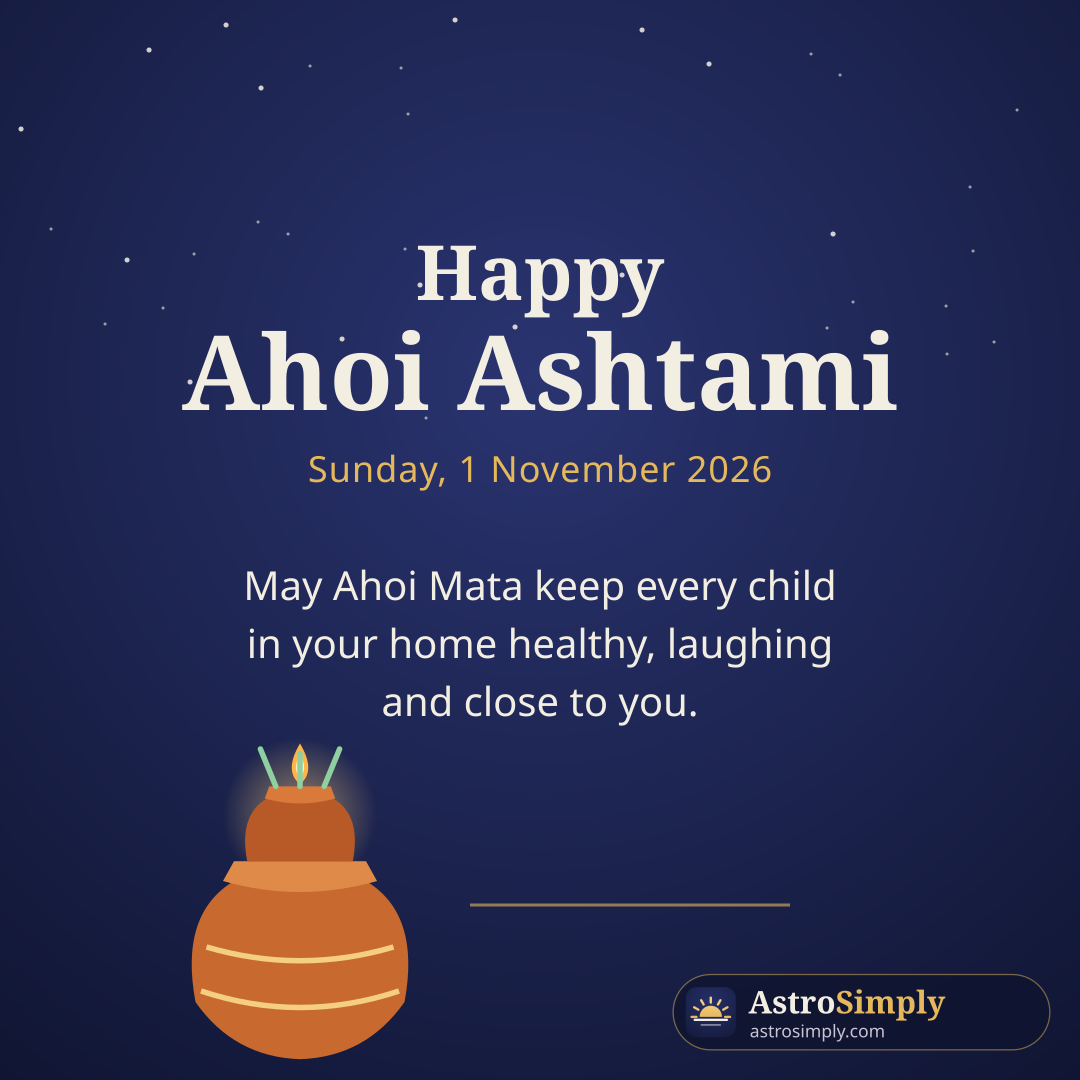
- Happy Ahoi Ashtami. May Ahoi Mata keep every child in your home healthy, laughing and close to you.
- To every mother who keeps the fast today: may the stars come out early, and may your prayers be answered many times over.
- Ahoi Ashtami ki shubhkamnayein. May your children grow in wisdom, your home in warmth, and your heart in peace.
- For my mother: you kept this fast for me every year. Today I keep it in my heart for you. Happy Ahoi Ashtami.
The cards under this post can be shared straight to WhatsApp.
Frequently asked questions
Can I break the fast on the stars if my family tradition is the moon?
Yes, and most families now do. The moon on this Ashtami rises close to midnight in every Indian city, and the older custom of the vrat, as Drik Panchang notes, is the stars at twilight. If your mother-in-law or the elders keep the moon custom, ask them; many have moved to the stars for exactly this reason.
Is Ahoi Ashtami only for mothers of sons?
It began that way in the katha, but the vrat today is kept for all children, daughters as well as sons, and by many grandmothers and by women hoping for a child. The prayer is for the well-being of the family’s children, and no rule narrows it.
My town isn’t in the table. How do I find the star time?
Take your city’s sunset and add about twenty-five minutes; that is what Drik Panchang’s figures come to for every city in the table. The panchang in the app gives sunset, the tithi and the nakshatra for any town you choose, in Hindi or English.
Sources
Read next
Karwa Chauth 2026: moonrise time city by city and the puja muhurat
Karwa Chauth 2026 is on Thursday 29 October. Moonrise and puja timings for ten cities, why the moon rises late, the day's panchang, and wishes to share.

Diwali 2026 Lakshmi Puja muhurat: why Pradosh kaal and a fixed lagna
Diwali 2026 is on Sunday 8 November. The Lakshmi Puja window, city by city, how the muhurat is worked out from Amavasya tithi, Pradosh kaal and a fixed lagna.
Baby name by nakshatra: the 108 pada syllables and how to use them
How Namakaran picks a baby's first syllable from the Moon's nakshatra and pada. The full table of 108 letters, a worked example, regional customs, odd sounds.