Vivah Muhurat 2026: why only 11 wedding days are left
Vivah muhurat 2026: why weddings pause, why Dev Uthani Ekadashi on 20 Nov reopens them, and all 11 wedding dates for Delhi to 15 Dec, checked step by step.
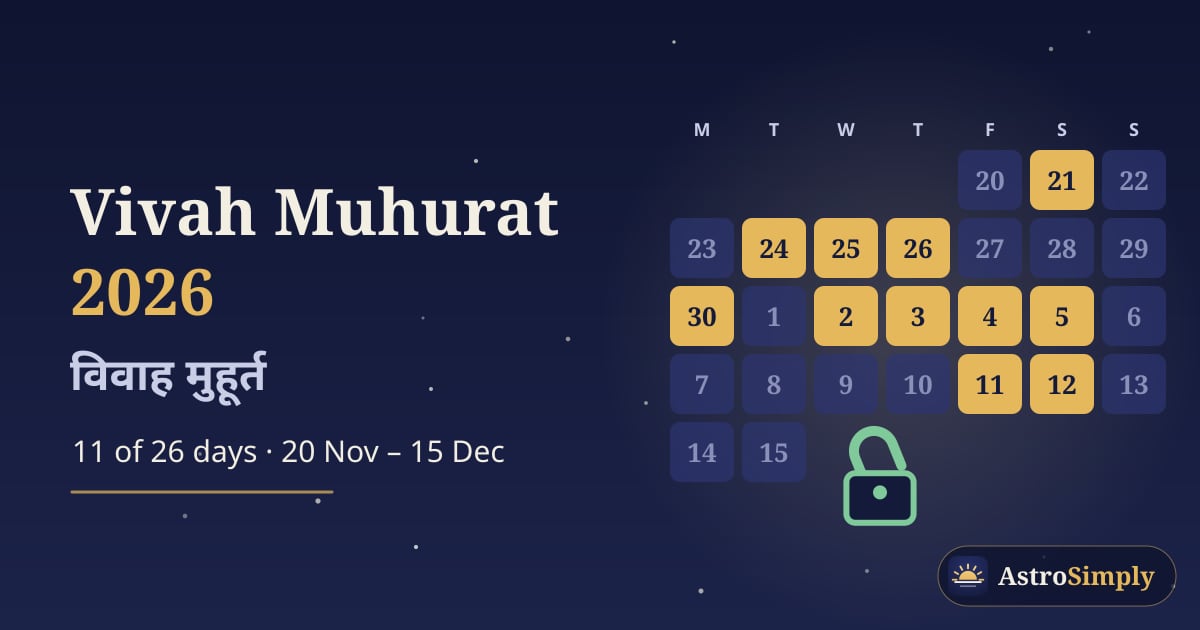
For four months, Hindu weddings have mostly waited. On Friday 20 November 2026, the ekadashi of the gods’ awakening (Dev Uthani or Prabodhini Ekadashi), the calendar opens again, and by the middle of December it closes for another month. Between those two dates, how many days actually work for a wedding? We checked every one of them with our own panchang for Delhi, and the answer is 11 days.
▶ Watch the video on YouTube: https://youtube.com/watch?v=qxEpPeL2SqY
This post explains why the wedding calendar has “locks”, why Dev Uthani reopens it, and how a vivah muhurat is chosen, with the full table of dates and a step-by-step example you can repeat for your own city. It follows our explainer Muhurat: why timing matters, where we saw that a muhurat began as a 48-minute slice of the day.
The four locks on the wedding calendar
A vivah muhurat is checked at four scales: the season, the month, the day and the hour. Before anyone looks at a single day, about half the year is already closed in the classic calendar.
| Lock | What tradition says | 2026–27 (our engine, Lahiri, Delhi) |
|---|---|---|
| 1. The gods’ rest (Chaturmas) | From Devshayani Ekadashi to Dev Uthani Ekadashi the gods rest; the months are kept for prayer, fasting and study, and weddings wait | 25 July → 20 November 2026 (118 days) |
| 2. Venus and Jupiter visible | No wedding while Venus (love and marriage) or Jupiter (wisdom and blessing) is “set” (ast), lost in the Sun’s glare | Venus passed in front of the Sun around 24 October; 15° clear on 3 November, 34° on 20 November. Jupiter stays more than 60° from the Sun all season |
| 3. The Sun’s pause (Kharmas) | While the Sun is in Sagittarius (Dhanu) or Pisces (Meena), both signs of Jupiter, new beginnings pause | Sun enters Sagittarius on 16 December 2026 and Capricorn on 14 January 2027 (Makar Sankranti) |
| 4. The day itself | The day’s panchang has to suit a wedding (see below) | 11 of the 26 days from 20 November to 15 December pass |
So with locks 1–3 open, the window after Dev Uthani is 20 November to 15 December 2026: 26 days. After that the Sun’s month in Sagittarius begins, and weddings resume from mid-January 2027.
Lock 1: the gods’ rest (Chaturmas)
Tradition says that on Devshayani Ekadashi (Ashadha Shukla Ekadashi) the gods go to rest, and wake on Prabodhini Ekadashi (Kartika Shukla Ekadashi), four months later. This year our panchang puts Devshayani Ekadashi on Saturday 25 July 2026 and Dev Uthani Ekadashi on Friday 20 November 2026: 118 days. These are not bad months. They are set aside for prayer, fasting and study, so weddings and other big beginnings simply wait.
The ekadashi tithi begins at 07:16 on 20 November and ends at 06:32 on 21 November, before the next sunrise (06:48), so the 21st is already Dwadashi at sunrise. Major panchangs list Dev Uthani Ekadashi on 20 November for most families (some Vaishnava calendars keep the fast on the 21st). On the next day many families celebrate Tulsi Vivah, the marriage of the holy basil plant, the first wedding of the season.
Lock 2: Venus and Jupiter must be visible
When a planet comes close to the Sun in the sky it disappears in the glare; tradition calls it ast, “set”. The muhurat texts say no wedding while Venus or Jupiter is set. Venus stands for love and marriage, Jupiter for wisdom and blessing.
In 2026 Venus passed between the Earth and the Sun (moving retrograde) around 24 October. Our engine shows it moving clear: about 9° from the Sun on 30 October, 15° on 3 November, 30° on 15 November and 34° on 20 November. So this lock was already open before the gods’ awakening. Jupiter stays far from the Sun all season (more than 60° in late October, over 90° from 20 November).
Lock 3: the Sun’s pause (Kharmas)
When the Sun is in Sagittarius or Pisces, the two signs ruled by Jupiter, new beginnings such as weddings and house-warmings pause. In our calculation the Sun enters Sagittarius on 16 December 2026 (Dhanu Sankranti) and Capricorn on 14 January 2027 (Makar Sankranti); the Pisces month falls around mid-March to mid-April.
Myth vs fact. Kharmas is often called an “unlucky month”. It isn’t: it’s a month to pause new beginnings and turn to prayer, charity and giving. Ordinary life, work and travel go on as normal. Nothing is cursed.
Lock 4: the day itself
The day’s own panchang has to suit a wedding. The checks we used are the common classical ones:
- Nakshatra (the Moon’s star): one of the 11 traditional wedding nakshatras: Rohini, Mrigashira, Magha, Uttara Phalguni, Hasta, Swati, Anuradha, Mula, Uttara Ashadha, Uttara Bhadrapada and Revati.
- Tithi: not one of the rikta (“empty”) tithis, the 4th, 9th and 14th, and not Amavasya (new moon).
- Bhadra: no Vishti karana (Bhadra), the half-tithi that is avoided for any new start.
- Yoga: not one of the nine harsh yogas (Vishkambha, Atiganda, Shula, Ganda, Vyaghata, Vajra, Vyatipata, Parigha, Vaidhriti).
- Time: all four together for at least one full muhurat, 48 minutes, between sunrise and the next sunrise.
A real date, step by step: Wednesday 2 December 2026
From sunrise (06:56) to the next sunrise (06:57), Delhi:
| Check | What our panchang shows | Result |
|---|---|---|
| Nakshatra | Purva Phalguni until 08:55, then Uttara Phalguni | passes from 08:55 |
| Tithi | Navami (9th, rikta) until 22:52, then Dashami | passes from 22:52 |
| Bhadra | karanas Taitila, Gara, Vanija: no Vishti | passes all day |
| Yoga | Vishkambha until 10:31, then Priti | passes from 10:31 |
| All together | 22:52 → 06:57 (3 Dec), 8 hours |
The window opens only at 10:52 at night, when the empty ninth tithi ends, which is exactly why so many North Indian weddings run late into the night.
All 11 days, 20 November – 15 December 2026 (Delhi)
Times are for New Delhi (28.61° N, 77.21° E) from our own panchang; a time after midnight belongs to the night of the date in the first column. Other cities differ by a few minutes.
| Date | Window | Tithi | Nakshatra |
|---|---|---|---|
| Sat 21 Nov | 06:48 → 02:30 (22 Nov) | Dwadashi | Uttara Bhadrapada, Revati |
| Tue 24 Nov | 23:25 → 06:51 (25 Nov) | Pratipada | Rohini |
| Wed 25 Nov | the whole day, 06:51 → 06:52 (26 Nov) | Pratipada, Dwitiya | Rohini, Mrigashira |
| Thu 26 Nov | 06:52 → 17:47 | Dwitiya, Tritiya | Mrigashira |
| Mon 30 Nov | 12:55 → 14:27 | Saptami | Magha |
| Wed 2 Dec | 22:52 → 06:57 (3 Dec) | Dashami | Uttara Phalguni |
| Thu 3 Dec | 06:57 → 10:54 and 23:04 → 06:58 (4 Dec) | Dashami, Ekadashi | Uttara Phalguni, Hasta |
| Fri 4 Dec | 06:58 → 10:22 | Ekadashi | Hasta |
| Sat 5 Dec | 11:48 → 06:59 (6 Dec) | Dwadashi, Trayodashi | Swati |
| Fri 11 Dec | 03:04 → 07:03 (12 Dec) | Tritiya | Uttara Ashadha |
| Sat 12 Dec | 07:03 → 14:06 | Tritiya | Uttara Ashadha |
What drops out. The nakshatra rule alone removes 8 of the 26 days (22, 23, 27, 28, 29 November and 13, 14, 15 December). Rikta tithis and the new moon remove 7 and 8 December. Harsh yogas remove 1, 9 and 10 December, and two days have less than one muhurat left: 20 November (only 16 minutes, just before the next sunrise) and 6 December (42 minutes).
Two twists. First, the day the season reopens, 20 November itself, passes for only 16 minutes by these strict rules; yet in many North Indian families Dev Uthani Ekadashi is treated as a day so blessed (an abujh muhurat) that weddings go ahead on it anyway. Second, we cross-checked with a well-known panchang (Drik Panchang’s 2026 marriage dates, New Delhi). It also lists 11 days in this window, and 10 of them are the same as ours: it leaves out 30 November and includes 6 December (07:00–07:42), and on some days its hours differ (for example it starts 2 December at 10:32, giving the ninth tithi less weight). Traditions weigh the rules a little differently, which is why the final choice is always made with your family astrologer.
Then the couple: the part no calendar can do
The calendar gives a starting list. A family astrologer then:
- compares the couple’s birth charts (kundali matching and the 36 gunas); you can try our free kundali matching tool;
- checks the dates against the bride’s and groom’s own Moon signs and the current transits;
- sets the exact moment by the lagna (rising sign) at the time of the pheras.
That’s why two families in the same city can end up with different “best” dates, and both be right.
Check any date yourself
- Today’s panchang shows the tithi, nakshatra, yoga and karana (including Bhadra) for your city, with their end times.
- The choghadiya tool shows the day’s good and bad slices, Rahu kaal and the Abhijit muhurat.
- Kundali matching works out the 36 gunas for a couple.
Frequently asked questions
When does the wedding season start after Chaturmas in 2026?
On Dev Uthani (Prabodhini) Ekadashi, Friday 20 November 2026. By the classic rules the first full wedding day in Delhi is Saturday 21 November, and 11 days pass the checks before the Sun enters Sagittarius on 16 December. After that, weddings resume from mid-January 2027, once the Sun enters Capricorn on 14 January.
Is Kharmas unlucky?
No. Kharmas is the month when the Sun is in Sagittarius, 16 December 2026 to 14 January 2027 this time. Tradition pauses new beginnings such as weddings and turns to prayer and charity, while daily life, work and travel go on as normal. Venus matters in the same spirit: while it is too close to the Sun to be seen, the texts advise waiting, and in 2026 it was clear well before 20 November.
Why are so many weddings late at night, and can we marry on a day that isn’t listed?
Because the panchang window often opens or closes at night: on 2 December 2026 it runs from 10:52 pm to 6:57 am. Many families do marry on days outside this list, for good reasons, and some treat Dev Uthani Ekadashi itself as auspicious. These rules describe the tradition; your family astrologer, looking at the couple’s charts, has the final word.
Wedding muhurat is explained here as a tradition, with respect. No day is cursed, and nothing here predicts how a marriage will go. Dates and times are for New Delhi from our own calculations (Lahiri ayanamsa).
Sources
Read next
Muhurat: why timing matters, and what makes a time good or bad
What a muhurat really is, the five layers that make a time good, what Rahu Kaal and Kaal choghadiya mean, and a real example: buying a car in Delhi.
Kundali matching: what the 36 gunas measure and how many are enough
The eight kootas behind the 36-point gun milan score, why 18 is the usual cut-off, and why a high total can still fail on Nadi or Bhakoot dosha.
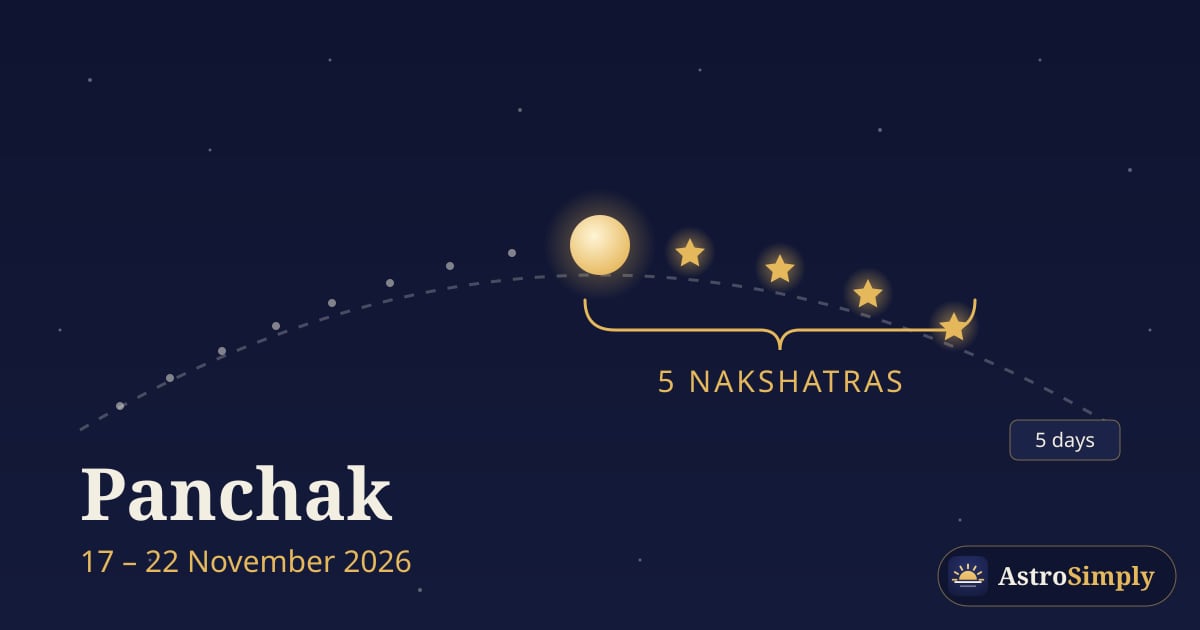
Panchak 17–22 November 2026: what it is, what waits, what doesn't
Panchak runs from 17 November 3:30 pm to 22 November 5:54 am IST in 2026. What the five-nakshatra period is, the five jobs tradition pauses, and what goes on.