Kundali matching: what the 36 gunas measure and how many are enough
The eight kootas behind the 36-point gun milan score, why 18 is the usual cut-off, and why a high total can still fail on Nadi or Bhakoot dosha.
The “36 gunas” of kundali matching come from eight tests, called kootas, that compare the bride’s and groom’s Moon signs and birth nakshatras. The tests carry different weights, from one point to eight, and the weights add up to 36. By the convention followed across North India, a total of 18 or more is acceptable and anything below is not. But a total alone can mislead: Drik Panchang states that if Nadi, the heaviest koota, is unfavourable, even a match scoring 28 is considered inauspicious.
So the useful question is not “how many gunas?” but “which gunas, and did any of the two heavy ones fail?” This post walks through the eight tests, the score bands astrologers actually use, and the two doshas that can override a good number.
The eight kootas and what each one weighs
| Koota | Points | What it compares | What it is said to indicate |
|---|---|---|---|
| Varna | 1 | A class assigned to each Moon sign | Temperament and ego balance |
| Vashya | 2 | Groups of signs that are said to influence one another | Mutual attraction and influence |
| Tara | 3 | The count between the two birth nakshatras | Fortune and well-being of the pair |
| Yoni | 4 | An animal symbol for each nakshatra | Physical and instinctive compatibility |
| Graha Maitri | 5 | Friendship between the lords of the two Moon signs | Mental rapport, shared outlook |
| Gana | 6 | Deva, Manushya or Rakshasa nature of each nakshatra | Basic nature, how arguments go |
| Bhakoot | 7 | The distance between the two Moon signs | Emotional bond, family and finances |
| Nadi | 8 | One of three nadis assigned to each nakshatra | Health and progeny; the heaviest koota |
Everything here runs on just two pieces of information per person: the Moon sign and the birth nakshatra. That is why the match can be done in a few minutes with a panchang, and also why it is only a first screen. Nothing in the 36 points looks at the 7th house, Venus, Mars or the dasha. Those come later.
A note on Varna: the word maps onto the old four-fold class system, and Drik Panchang’s tables do assign Moon signs to Brahmin, Kshatriya, Vaishya and Shudra categories. In matching it has nothing to do with the families’ actual caste; it is a one-point test of temperament, and the groom’s sign need only be equal or “higher” to score it. Most astrologers treat it as the least consequential of the eight.
How the total is read
Drik Panchang publishes two sets of bands, depending on whether Bhakoot came out favourable.
When Bhakoot is favourable (7 points):
- 31 to 36: excellent
- 21 to 30: very good
- 17 to 20: middling
- 0 to 16: inauspicious
When Bhakoot is unfavourable (0 points):
- 26 to 29: very good
- 21 to 25: middling
- 0 to 20: inauspicious
- Never “excellent”, whatever the total
The popular cut-off of 18 sits inside the “middling” band. It is a convention, not a verse. Astrologers keep it because once a total drops below 18, one of the heavy kootas has almost certainly failed, and that failure is the thing worth examining.
The two doshas that can veto a good score
Nadi dosha
Each of the 27 nakshatras belongs to one of three nadis: Aadi, Madhya or Antya. If the bride’s and groom’s nakshatras fall in the same nadi, Nadi scores zero and the match is said to carry Nadi dosha. Because Nadi is worth eight points and is tied to health and children, tradition gives it “supreme priority”, in Drik Panchang’s words.
Commonly accepted exceptions soften this. When the two Moon signs are the same but the nakshatras differ, or the nakshatra is the same but the padas differ, many astrologers do not count the dosha. Lineages vary on exactly which of these exceptions they accept, so ask yours which rule was applied.
Bhakoot dosha
Bhakoot looks at where the two Moon signs stand from each other. Three relationships score zero: 2nd and 12th from each other, 5th and 9th, and 6th and 8th. The rest score the full seven. The 6/8 relationship is treated as the hardest, the 2/12 as the next, and the 5/9 as the mildest. The common exception is that the dosha is set aside when the lords of the two signs are friends, or are the same planet, which is why an Aries–Scorpio pairing (both ruled by Mars) is usually passed despite being 8/6.
Our match engine in the AstroSimply app checks Tara, Bhakoot and Nadi, and for Bhakoot it uses exactly these three relationships.
A worked example
Two families receive a matching sheet showing 23 out of 36. On its own, 23 is “very good”. But the breakdown reads: Varna 1, Vashya 2, Tara 3, Yoni 3, Graha Maitri 4, Gana 5, Bhakoot 7, Nadi 0. All of the deficit sits in Nadi. The groom’s Moon is in Rohini and the bride’s in Magha, and both of those nakshatras belong to the Antya nadi. Their Moon signs, Vrishabha and Simha, are different, so the same-sign exception does not apply.
By Drik Panchang’s rule this match is inauspicious despite its 23 points. A thoughtful astrologer would then look beyond the kootas: the strength of the 5th house in both charts, Jupiter’s condition, and whether each chart independently supports what the nadi test is worried about. If those are strong, many will pass the match with a simple shanti ritual; if they are weak too, they will say so. Compare that with a second couple scoring 19, with Nadi 8 and Bhakoot 7, who lost points across Yoni, Gana and Graha Maitri. Their lower total is structurally healthier, because no heavy koota failed.
That is the whole lesson of gun milan in one example: read the breakdown before the total.
What gun milan does not cover
The ashtakoot system was designed as a quick nakshatra-based screen, and it leaves out things that an actual compatibility reading needs:
- Mangal dosha in either chart. It is assessed separately; our post on checking Mangal dosha in your own kundali explains how.
- The 7th house and its lord in each chart, which describe the marriage itself.
- Venus (and Jupiter in a woman’s chart, by tradition), the karakas for partner and husband.
- Dasha timing: two people in difficult periods at the same time will feel strain whatever the gunas say.
- The lagna: everything in gun milan is from the Moon. Two charts can score 30 from the Moon and still have clashing lagnas.
A good pandit will do the gun milan first because the families expect it, and then spend most of the time on these.
What to ask when you are handed a score
- “Which kootas scored zero, and why?” The answer tells you more than the total.
- “If Nadi or Bhakoot failed, which exception rule did you check?”
- “Did you look at Mangal dosha in both charts?”
- “What do the 7th houses and Venus say?”
If you want to try the first screen yourself, you only need each person’s Moon sign and nakshatra. Our post on understanding your Moon sign explains where they come from, and the AstroSimply app shows both on each family member’s kundali.
Frequently asked questions
Is 18 out of 36 really enough to marry?
By convention, yes, provided Nadi and Bhakoot both scored their full points and neither chart has an uncancelled Mangal dosha. A total of 18 with Nadi 0 is a different and weaker case. Many families aim for 24 or more, but the band tables above show that 21 to 30 is already “very good” when Bhakoot is favourable.
Can a score of 32 still be a poor match?
Yes, in two ways. First, because gun milan ignores the lagna, the 7th house, Mars and the dashas, a high koota score can sit on top of charts that disagree on those. Second, the kootas repeat information: Bhakoot, Graha Maitri and Vashya all derive from the Moon signs, so a lucky pair of signs can inflate the total without saying anything new.
Do South Indian families use the same 36 points?
Not exactly. South Indian matching uses a ten-koota system (dasha koota or porutham) with a different set of tests, including Rajju and Vedha, and no points total. The North Indian ashtakoot method described here is the one behind the familiar “x out of 36” number. If one family is from the south and the other from the north, it is worth having both done.
Sources
Read next
Mangal dosha: how to check your own kundali, and when it cancels
Which houses of Mars count as Mangal dosha, why you must check from lagna, Moon and Venus, the accepted cancellations, and what the dosha does not mean.
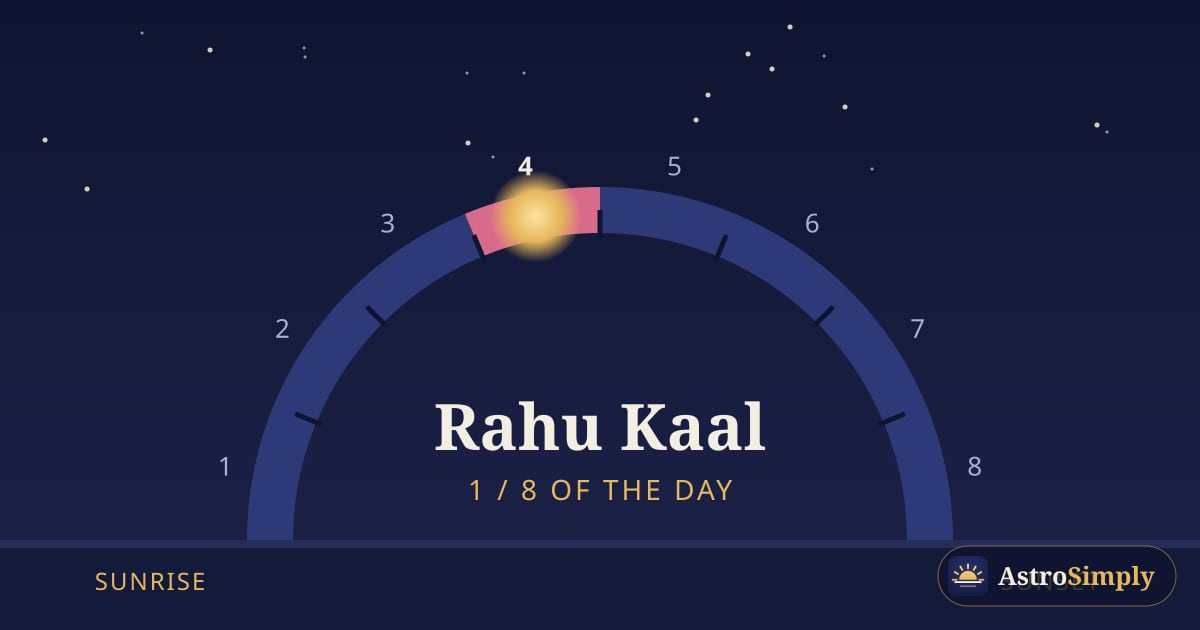
Rahu kaal: how it is calculated for your city, and what it is for
Rahu kaal is one eighth of the daylight, chosen by the weekday. The arithmetic with a real day, the weekday table, where it comes from, what it doesn't stop.
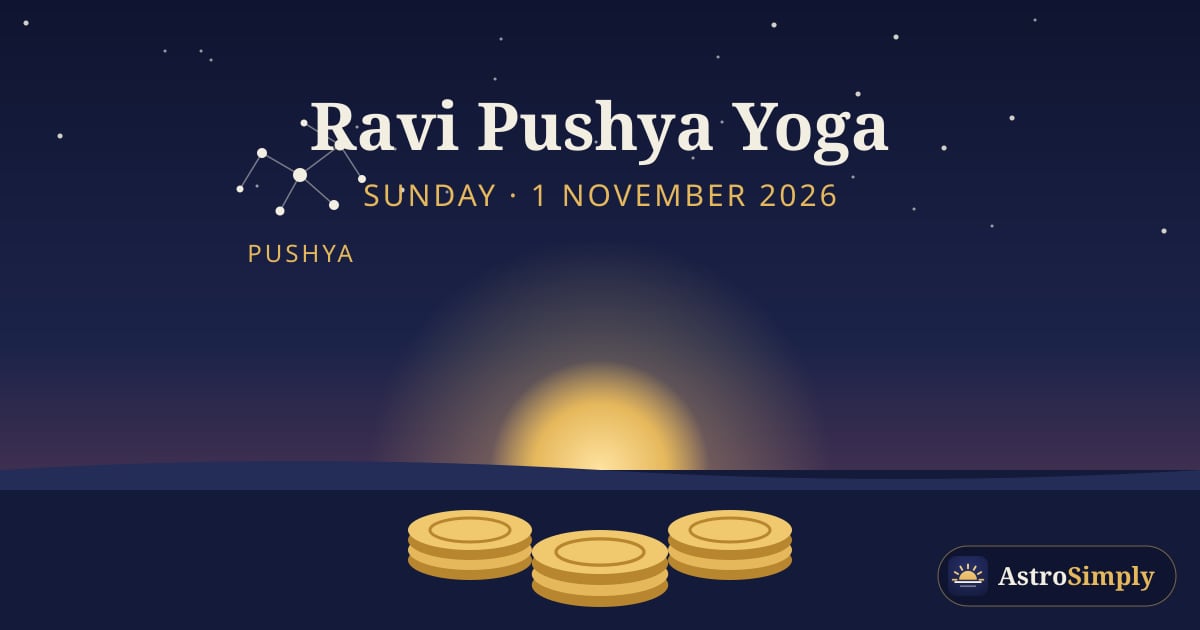
Ravi Pushya on 1 November 2026: the shopping day before Dhanteras
Ravi Pushya yoga falls on Sunday 1 November 2026, five days before Dhanteras. The window, the best Choghadiya, Rahu kaal to skip, and what people buy.