Panchak 17–22 November 2026: what it is, what waits, what doesn't
Panchak runs from 17 November 3:30 pm to 22 November 5:54 am IST in 2026. What the five-nakshatra period is, the five jobs tradition pauses, and what goes on.
Share these images
Send them to family and friends on WhatsApp, or save them to your phone.
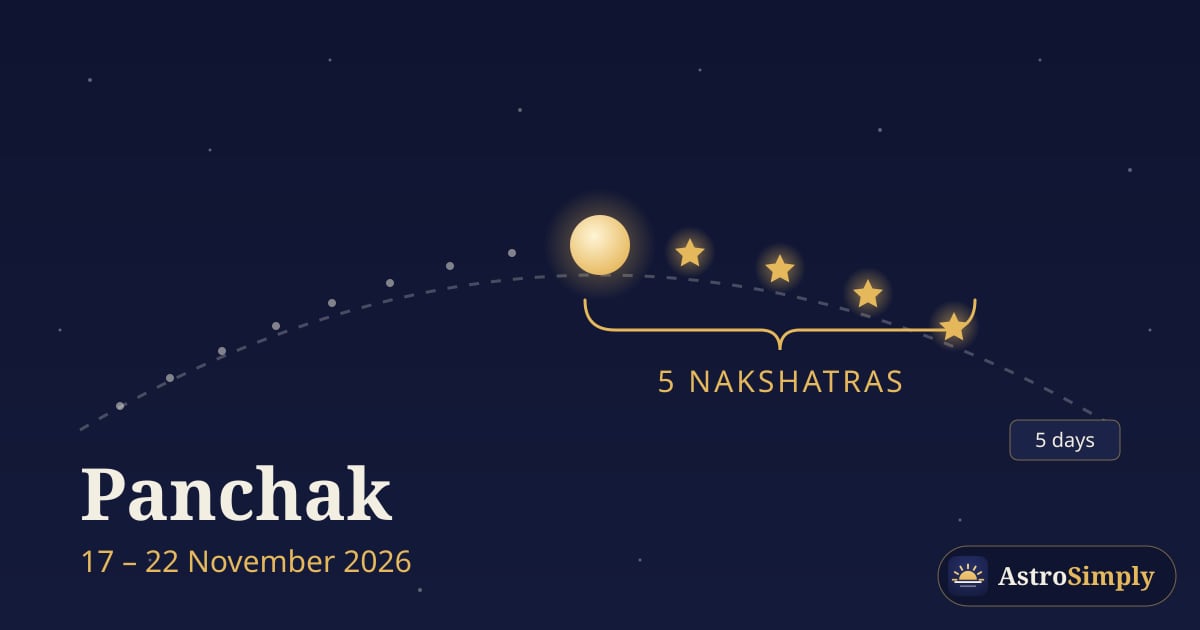
Panchak begins on Tuesday 17 November 2026 at 3:30 pm and ends on Sunday 22 November at 5:54 am (IST, the same for every city in India; AstroSimply’s own calculation). It’s the stretch of about five days, once a month, when the Moon crosses the last five nakshatras of the zodiac. Tradition asks you to put off five particular jobs in these days, and nothing else: work, school, shopping, puja and this week’s festivals go on exactly as usual.
People ask me about Panchak more than about almost any other panchang term, usually in a worried voice. So here are the questions I hear most, answered plainly, with this month’s exact times and the dates till March 2027.
What exactly is Panchak?
The Moon goes round the zodiac in about 27 days, passing through the 27 nakshatras (lunar stars) one after another. The last five of them are Dhanishta, Shatabhisha, Purva Bhadrapada, Uttara Bhadrapada and Revati. While the Moon is in that final stretch, roughly the last 60 degrees of the circle, the days are called Panchak, “the group of five”.
One detail matters for the clock. Dhanishta straddles two signs: its first half lies in Makara (Capricorn) and its second half in Kumbha (Aquarius). Panchak starts only when the Moon crosses into Kumbha, at the third quarter (pada) of Dhanishta, not when Dhanishta begins. So the simplest way to say it: Panchak is the time the Moon spends in Kumbha and Meena (Pisces). It ends the moment the Moon enters Mesha (Aries), which is also the start of Ashwini nakshatra.
Because the Moon takes a little under five days to cover those two signs, and comes back to them every 27.3 days, every month has one Panchak of four and a half to five days.
When is Panchak in November 2026, hour by hour?
Here is the whole period from our panchang, nakshatra by nakshatra. The times are IST and apply to the whole country.
| The Moon is in | From | To |
|---|---|---|
| Dhanishta, second half (Moon enters Kumbha) | Tue 17 Nov, 3:30 pm | Wed 18 Nov, 4:34 am |
| Shatabhisha | Wed 18 Nov, 4:34 am | Thu 19 Nov, 6:10 am |
| Purva Bhadrapada | Thu 19 Nov, 6:10 am | Fri 20 Nov, 6:56 am |
| Uttara Bhadrapada | Fri 20 Nov, 6:56 am | Sat 21 Nov, 6:50 am |
| Revati (Panchak ends as the Moon enters Mesha) | Sat 21 Nov, 6:50 am | Sun 22 Nov, 5:54 am |
Since the period ends before sunrise on Sunday 22 November, the whole of Sunday is clear.
We cross-checked these times with Astromitra’s Panchak table for New Delhi, which gives exactly the same start and end. You may see other calendars that differ by up to an hour; that usually comes from a different ayanamsa (the correction that lines the zodiac up with the stars). Ours uses Lahiri, the one most Indian panchangs follow. If you’d like the background, read why Vedic and Western signs differ.
Why is this one called Agni Panchak?
Tradition names each Panchak after the weekday on which it begins:
| Panchak begins on | Traditional name | What the name points to |
|---|---|---|
| Sunday | Rog Panchak | health; a time for rest rather than exertion |
| Monday | Raj Panchak | dealings with authority and property; often read as mild or even helpful |
| Tuesday | Agni Panchak | fire; extra care with fire-related work |
| Wednesday or Thursday | no special name | considered free of the Panchak restriction |
| Friday | Chor Panchak | loss; keep valuables close, especially while travelling |
| Saturday | Mrityu Panchak | the one tradition treats most strictly for the five jobs below |
These names are old reminders of what to be careful about in a given week. They aren’t predictions about anybody, and no text I know of says anything will go wrong because the Moon is in Meena. This month’s Panchak begins on a Tuesday, so it is an Agni Panchak. Practically, that means tradition puts a little extra weight on the fire-related items in the list below: stocking fuel, and starting fire-related work such as lighting a new furnace or kiln for the first time. Cooking, lighting diyas, havan at a puja, and the lamps of Tulsi Vivah are everyday fire and are not affected at all.
What does tradition ask us to pause?
Just five things. In the muhurta (electional) tradition they are:
- Collecting or stocking wood, grass or fuel. The oldest reason is practical: fuel stored under a thatched roof in a dry season was a fire risk, and the rule became a calendar habit.
- Laying a roof or casting the slab of a house. The walls, the plastering and everything else can carry on; it’s the roof itself that waits.
- Making or buying a bed or cot (palang, charpai). Buying a mattress or bedsheets is not in the rule.
- Starting a journey towards the south. Travel in any other direction, and journeys that are already under way, are not affected.
- The last rites. This is the part families hold to most carefully. The rite is never postponed; tradition asks the family priest to add a short shanti to it, which is why your priest will ask for the date and time. I’d leave the details to the priest; it’s a gentle rite and nothing to be afraid of.
There is a saying that a job done in Panchak “comes back five times”. Treat it as the memorable form of the rule, the way “measure twice, cut once” is, not as a threat.
What is NOT stopped by Panchak?
Everything that isn’t in that list of five: office and school, shopping, signing routine paperwork, cooking, visiting relatives, travelling north, east or west, and all puja, fasts and festivals.
This month makes the point nicely. Dev Uthani Ekadashi falls on Friday 20 November and Tulsi Vivah on 21 November, both well inside Panchak, and both are observed in full; nobody has ever moved the gods’ awakening for the Moon’s position. Even more telling: the muhurta texts count Uttara Bhadrapada and Revati, two of the five Panchak nakshatras, among the eleven nakshatras preferred for weddings. That’s why Saturday 21 November is a wedding day in our list of 11 vivah muhurat dates for 2026. A nakshatra can be in Panchak and be excellent for a wedding at the same time, because Panchak was never about weddings.
Some families also wait for a griha pravesh (house-warming) or a big property purchase till Panchak is over. That’s a family custom, not one of the five, and it’s fine either way; if you want to do the house-warming anyway, pick a good choghadiya on the day and go ahead.
Does Panchak change from city to city?
No. The Moon’s nakshatra is the same for Varanasi, Mumbai and Chennai at any given moment, so Panchak begins and ends at the same minute everywhere in India. This makes it different from Rahu kaal, which depends on your city’s sunrise and sunset. If you’re outside India, convert from IST: 17 November 3:30 pm IST is 10:00 am in London and 5:00 am in New York.
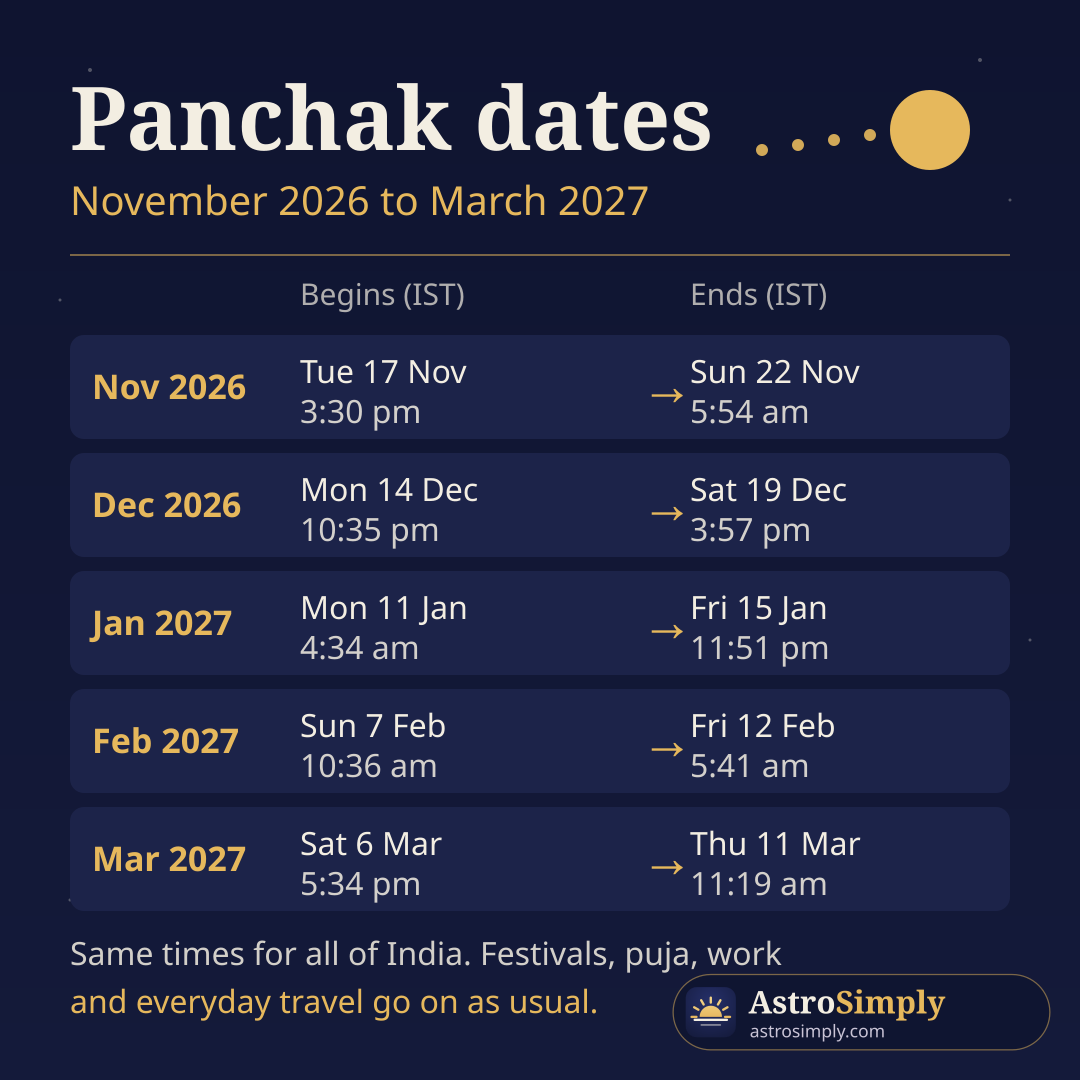
Panchak dates till March 2027
From our panchang, Lahiri ayanamsa, IST:
| Panchak | Begins | Ends | Begins on a |
|---|---|---|---|
| November 2026 | Tue 17 Nov, 3:30 pm | Sun 22 Nov, 5:54 am | Tuesday (Agni) |
| December 2026 | Mon 14 Dec, 10:35 pm | Sat 19 Dec, 3:57 pm | Monday (Raj) |
| January 2027 | Mon 11 Jan, 4:34 am | Fri 15 Jan, 11:51 pm | Monday (Raj) |
| February 2027 | Sun 7 Feb, 10:36 am | Fri 12 Feb, 5:41 am | Sunday (Rog) |
| March 2027 | Sat 6 Mar, 5:34 pm | Thu 11 Mar, 11:19 am | Saturday (Mrityu) |
Notice how the weekday slips back by about one day each month: the Moon’s round of the zodiac takes 27.3 days, about 17 hours short of four weeks, so each Panchak begins a little earlier in the week than the last, and its name changes with it.
What if one of the five jobs can’t wait?
Tradition has always had answers, all of them simple. The first is to wait the few days, which is usually possible for a roof or a cot. If a journey south can’t wait, families start it with a short prayer at home, and go. For a roof that has to be cast on a contractor’s schedule, many families have the priest do a small Panchak shanti first, or begin the work with a brief puja. None of this is expensive, and none of it is compulsory; the choice is yours.
Where does the rule come from?
Panchak belongs to muhurta, the branch of jyotish that chooses times for things, and it has come down mainly through the regional panchangs rather than through a single famous verse. It is observed most strictly in Uttar Pradesh, Bihar, Rajasthan and Madhya Pradesh, and much more lightly in the south, where many families don’t mark it at all. The explainers at Dekho Panchang and AstroMedha give a good plain summary of the rule and its regional spread, and I’ve relied on them for that part.
If you’d like to see where the Moon is right now, today’s panchang shows the nakshatra with its end time for your city, and the Panchang tool in the app does the same for any date. For picking a good day for a roof, a vehicle or a house-warming once Panchak is over, the Muhurat finder checks the tithi, nakshatra and yoga together.
Frequently asked questions
Can I travel during Panchak?
Yes. Tradition only asks you not to begin a journey towards the south in these days; travel in other directions, return journeys, and trips already under way are not affected. If a southward journey can’t be moved, start it after a short prayer at home and go in peace. Many families, especially in the south of India, don’t observe this rule at all.
Can I buy a car, gold or property during Panchak?
None of these is among the five things tradition pauses in Panchak, and people buy cars and gold through these days every month. Some families prefer to wait for a griha pravesh or a large property deal, which is a custom rather than a rule. For any purchase, the day’s choghadiya and the Abhijit muhurat on our panchang page are the better guide.
Why does another calendar show a different Panchak time?
Three reasons, usually. Some sites give the whole of Dhanishta as Panchak instead of its second half, which makes the start about half a day early. Some use a different ayanamsa, which moves every nakshatra boundary by up to an hour. And a few list times for a city abroad. Our times use the Lahiri ayanamsa and IST, and for November 2026 they match Astromitra’s Delhi table exactly.
Panchak is described here as the tradition describes it, with respect. It predicts nothing about anyone; it’s a calendar habit about five specific jobs. All times are AstroSimply’s own calculation, IST, Lahiri ayanamsa.
Sources
- Astromitra: Panchak dates and timings (New Delhi), used to cross-check our times
- Dekho Panchang: Panchak explained (nakshatras, works avoided, regional observance)
- AstroMedha: What is Panchak? The five-day Moon window explained
- PanchangBodh: Panchak yoga 2026 (a calendar with slightly different times)
- Hindu Blog: Upcoming Hindu festivals in November 2026
- Nakshatra (Wikipedia)
Read next
Muhurat: why timing matters, and what makes a time good or bad
What a muhurat really is, the five layers that make a time good, what Rahu Kaal and Kaal choghadiya mean, and a real example: buying a car in Delhi.
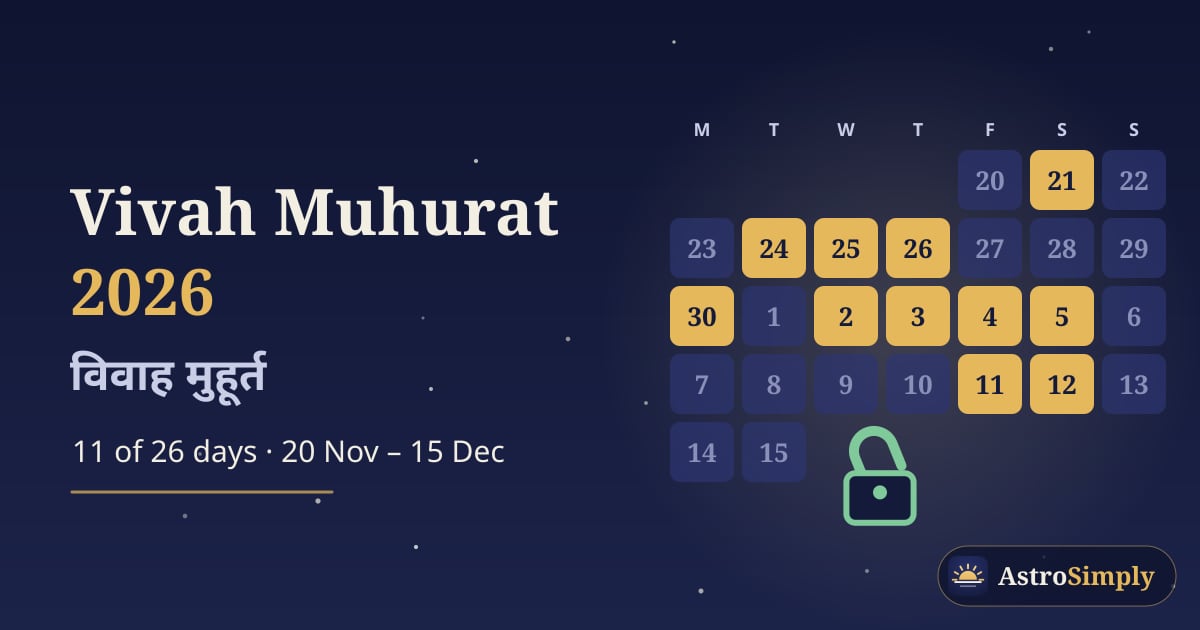
Vivah Muhurat 2026: why only 11 wedding days are left
Vivah muhurat 2026: why weddings pause, why Dev Uthani Ekadashi on 20 Nov reopens them, and all 11 wedding dates for Delhi to 15 Dec, checked step by step.
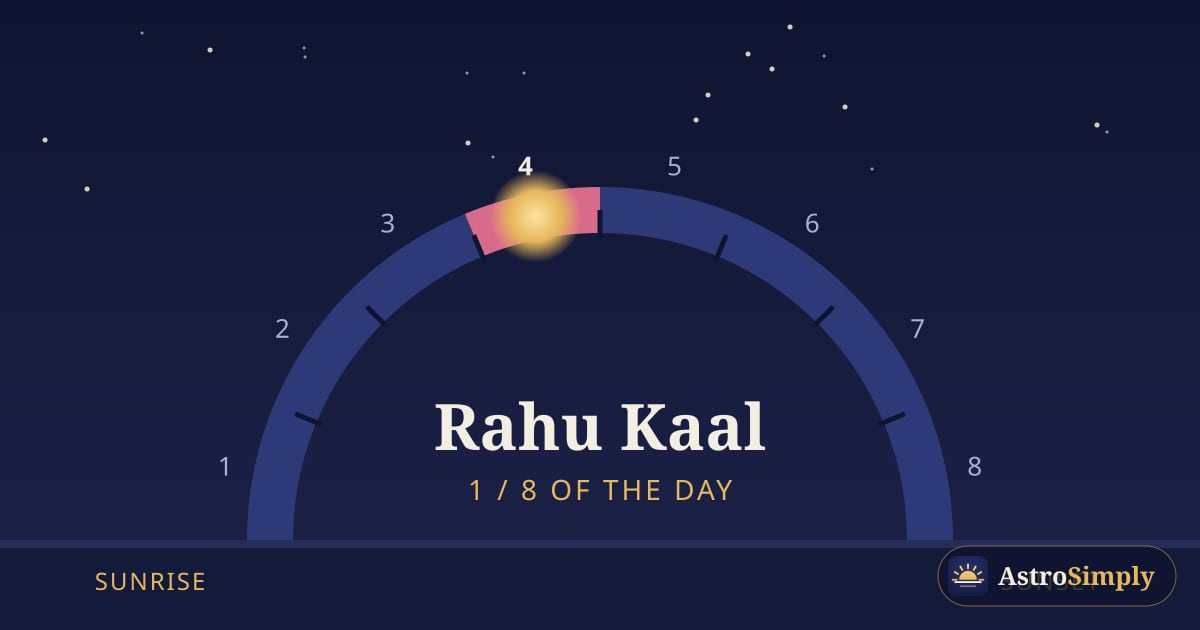
Rahu kaal: how it is calculated for your city, and what it is for
Rahu kaal is one eighth of the daylight, chosen by the weekday. The arithmetic with a real day, the weekday table, where it comes from, what it doesn't stop.